


Table of Contents
A visitor management solution for events helps organizers manage the complete visitor journey, from pre-registration and verification to check-in, badge printing, access control, and attendance tracking. Based on event size and security requirements, organizers can use QR-code check-in, self-service kiosks, facial recognition, turnstiles, manual check-in, or a combination of these methods.
The right solution should reduce entry friction while giving organizers real-time visibility and better control over who enters the venue and specific event areas. For large events, the best approach is usually to combine automated technology with trained staff and a reliable backup process.
For an event organizer, the visitor experience begins long before the first keynote, exhibition booth, or networking session. It starts the moment someone arrives at the venue.
If guests have to search for their registration details, stand in a long queue, fill out paper forms, or wait while staff manually verify their information, the event experience can feel disorganized before it has even started.
This is where a visitor management solution for events comes in. A 2026 analysis of 227,396 timestamped check-ins across 688 live events found that the median event had about 51% of opening-day check-ins occur within a single 60-minute window. About 32% occurred within a 30-minute window.
Instead of relying on spreadsheets, paper lists, or multiple disconnected check-in desks, a visitor management solution can bring registration, identity verification, check-in, access control, badge printing, and attendance tracking into a more structured workflow.
But what exactly does visitor management mean for events? How does it work? And should you use QR codes, facial recognition, turnstiles, or traditional manual check-in?
Let’s find out here.
Table of Contents
What Is Visitor Management?
Visitor management is the process of registering, verifying, checking in, monitoring, and managing people entering an event venue.
According to a dataset, approximately 32% of opening-day check-ins happened during the busiest 30-minute period. The busiest hour began within two minutes of the published event start time in the median event.
In an event environment, “visitors” can include much more than regular attendees. You may need to manage:
- General attendees
- VIPs and special guests
- Speakers
- Exhibitors
- Sponsors
- Media
- Staff and volunteers
- Vendors and contractors
- Delegates
A visitor management solution digitizes and organizes this process so that event teams can know who is expected, who has arrived, where they are allowed to go, and when they entered or exited.
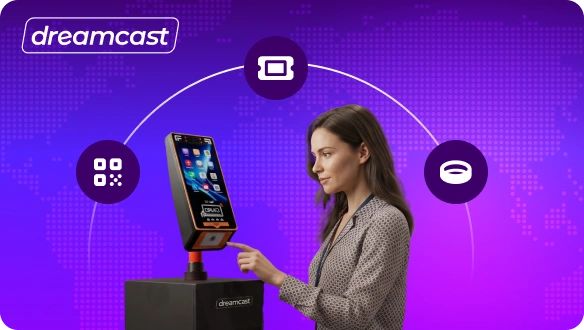
Modern systems can support QR-based check-in, facial recognition, self-service kiosks, digital passes, badge printing, and access-control integrations.
Why Do Events Need Visitor Management?
Think about an event with 5,000 attendees arriving within a short period.
If staff have to manually search registration lists, verify every guest, write down details, and distribute badges, even a small delay can quickly create a large queue.
A digital visitor management workflow changes that.
For example, an attendee who registered in advance could receive a QR code before the event. At the venue, they scan it, the system verifies their registration, and their check-in is recorded. Depending on the setup, their badge can then be printed or their access credential activated.
The result is a more predictable entry process for both attendees and organizers.
Visitor Management Is More Than Check-In
It is easy to think of visitor management as simply a faster way to check people in.
It is broader than that.
A complete solution can connect several stages of the visitor journey:
Pre-registration → Verification → Check-in → Badge/access → Onsite tracking → Check-out → Reporting
This creates a digital record of the visitor journey instead of leaving different pieces of information with different teams.
For event organizers, that can make it easier to manage attendance, monitor venue traffic, enforce access permissions, and review event data afterward.
How Do Visitor Management Solutions Work?
Although the exact workflow depends on the technology you choose, most event visitor management systems follow a similar journey.
Step 1: Register Visitors Before the Event

The process usually begins before the visitor reaches the venue.
Attendees can register through an online form or event registration platform. The organizer collects relevant information such as name, email address, organization, attendee category, and other event-specific details.
For VIPs, speakers, exhibitors, or restricted-access guests, additional information or approval steps can be added.
Pre-registration is important because it moves part of the workload away from the venue entrance.
Step 2: Issue a Digital Credential
Once registration is complete, the visitor can receive a digital credential such as a QR code, registration ID, or mobile pass.
This gives the visitor something that can be quickly verified when they arrive.
For example, QR-based visitor systems can send a unique code to a visitor before arrival and use that code for faster check-in at the venue.
Step 3: Verify the Visitor at the Venue
This is where the selected visitor management technology becomes important. Depending on the event, visitors may:
- Scan a QR code
- Use facial recognition
- Enter registration details
- Present an ID
- Check in through a kiosk
- Be verified manually by event staff
The system then checks whether the visitor is registered and what access they are entitled to.
Step 4: Complete Check-In and Issue Access
After verification, the visitor can be marked as checked in. The system may then:
- Print an attendee badge
- Issue a digital pass
- Activate a QR/RFID/NFC credential
- Open a turnstile
- Assign access permissions
- Notify event staff
For example, turnstile systems can connect credential verification with physical entry, allowing only authorized attendees to pass through.
Step 5: Track Attendance and Access
Once visitors enter, organizers can use a dashboard to monitor attendance information. Based on the solution, this can include:
- Total registered visitors
- Checked-in visitors
- Visitors yet to arrive
- VIP arrivals
- Entry times
- Zone access
- Session attendance
- Venue traffic
This gives event teams a more current picture of what is happening onsite.
Step 6: Record Check-Out and Generate Reports
Visitor management does not necessarily end when someone enters.
A complete system can also record when visitors leave and maintain a digital attendance history. Digital visitor logs can capture check-in and check-out information and make it available for reporting and auditing.
This data can help organizers understand attendance patterns and improve future event planning.
Types of Visitor Management Solutions for Events
Now comes the important question: which type of visitor management solution should you use?
There is no single answer.
The right option depends on your event size, security requirements, visitor volume, venue layout, attendee profile, and budget.
1) QR-Code Check-In
QR-code check-in is one of the simplest digital options for event entry.
After registering, attendees receive a unique QR code. At the venue, they present it on their smartphone, and staff or a scanning device verifies the credential.
21,196 participants were checked in by the largest event using RunSignup’s RaceDay CheckIn App. The report also notes that participants were increasingly familiar with checking into events via QR codes.
Best for: Conferences, exhibitions, corporate events, seminars, and high-volume events.
Advantages:
- Quick to deploy
- Familiar to attendees
- Easy to connect with registration
- Reduces manual data entry
- Can support multiple entry points
For large events, multiple scanning devices can be deployed to distribute visitor traffic across several entrances.
2) Facial Recognition Check-In
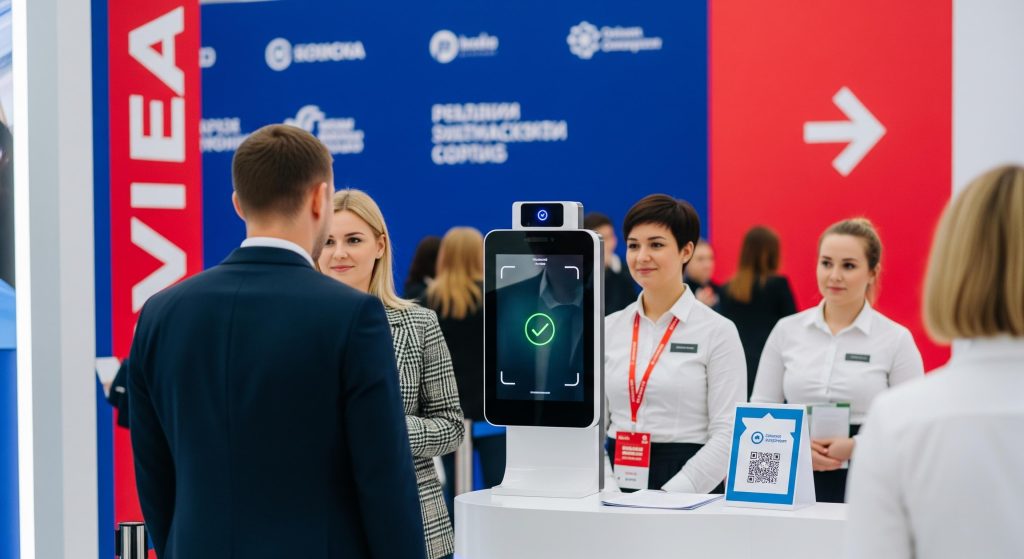
Facial recognition takes a more contactless approach.
50% of travelers had used biometric identification at an airport in 2025, and 85% of those who had used it said they were satisfied with the experience.
At an event, the visitor’s face can be matched against their registered profile, allowing the system to verify identity without requiring them to find a ticket or QR code. Event-focused solutions can combine facial recognition with kiosks, badge printing, or physical access control.
Best for: Large conferences, VIP events, controlled-access environments, and events looking for a highly contactless experience.
Advantages:
- Hands-free authentication
- No need to search for a QR code
- Can reduce manual verification
- Suitable for high-volume entry
- Can integrate with access-control systems
However, because facial recognition involves biometric data, organizers should consider consent, privacy, data protection, transparency, and applicable laws before implementing it.
3) Turnstile-Based Entry
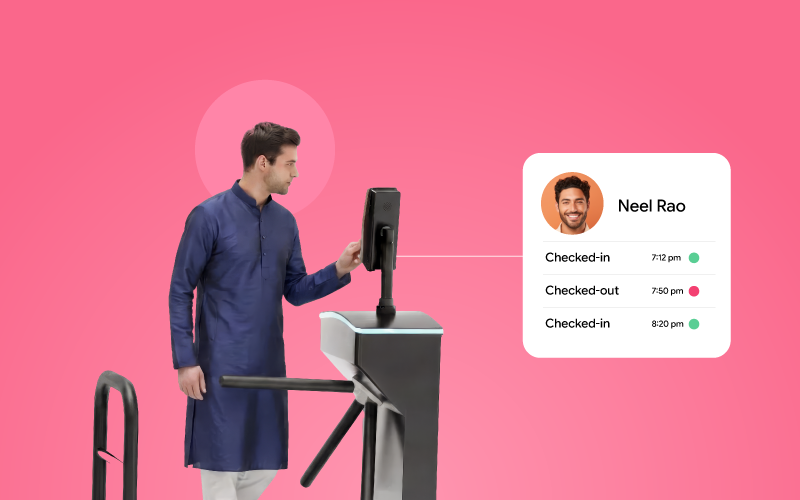
Turnstiles add a physical access-control layer to visitor management.
Instead of simply marking someone as checked in, the system can verify their credential and physically allow or deny entry. A 2026 stadium-access study using real turnstile data found an average throughput of approximately 15 spectators per minute at an access point, with around 4 seconds between individual entries.
Depending on the setup, turnstiles can support credentials such as QR codes, RFID, NFC, or facial recognition.
Best for: Large exhibitions, stadium-style venues, conferences, festivals, and events with controlled zones.
Advantages:
- Automated access control
- Faster movement through defined entry lanes
- Helps prevent unauthorized entry
- Can connect attendance with physical access
They are especially useful when the organizer needs to control who can enter specific areas, rather than simply recording attendance.
Read more about: Secure Exhibition and Expo Entry Management Using Intelligent Turnstile Gate Systems
4) Self-Service Kiosk Check-In
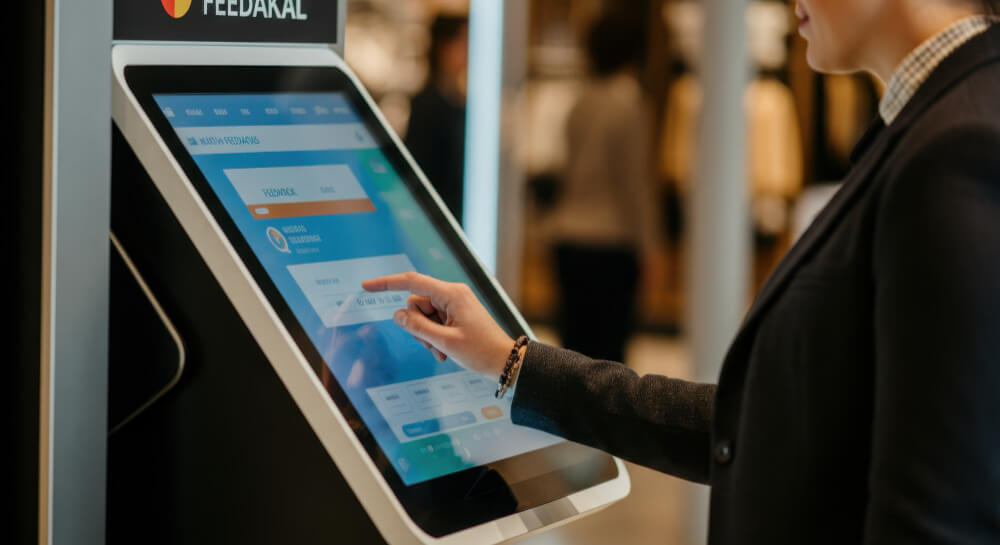
A self-service kiosk allows visitors to complete some or all of the check-in process themselves.
Based on the configuration, a visitor might scan a QR code, search for their registration, verify their identity, and receive a badge without requiring a staff member to handle every step.
The 2024 Community Brands Event Trends Study found that 27% of event professionals reported using onsite self-check-in technology, up from 24% in 2023.
Best for: Conferences, corporate events, exhibitions, and events with a large number of pre-registered attendees.
Advantages:
- Reduces pressure on registration desks
- Enables self-service entry
- Can support badge printing
- Helps distribute visitor traffic
Also Read: How Do Visitor Management Kiosks Make Self-Event Registration and Check-In Easier?
5) Manual Check-In
Manual check-in is the traditional approach, where event staff verify visitors against a guest list and record their arrival.
It may involve printed lists, spreadsheets, registration desks, or staff entering visitor details manually.
Best for: Small events, low-volume gatherings, or situations where technology is not practical.
The main limitation is scalability.
When hundreds or thousands of visitors arrive simultaneously, manual verification can create queues and increase the possibility of data-entry mistakes.
6) Hybrid Visitor Management
You do not necessarily have to choose only one method.
A large event can combine different visitor management options based on attendee type.
For example:
- General attendees: QR check-in
- VIPs: Facial recognition or dedicated VIP desk
- Speakers: Fast-track QR entry
- Walk-ins: Staff-assisted registration
- Restricted areas: Turnstile access
This hybrid approach can be particularly useful when different groups have different entry requirements.
Last Words
A visitor management solution for events is essentially about making visitor entry more organized, measurable, and manageable.
Instead of treating registration, verification, check-in, badge printing, access control, and attendance tracking as separate tasks, an integrated system can connect them into one visitor journey.
For a small event, manual check-in may still be enough. For a larger event, QR codes, self-service kiosks, facial recognition, turnstiles, or a combination of these technologies can help create a faster and more controlled experience.
The key is to choose based on your event size, visitor volume, security requirements, attendee categories, venue layout, and operational needs. Ultimately, visitor management is not just about getting people through the door.
It is about making sure they get through the door smoothly, securely, and with as little friction as possible.
FAQs
A visitor management solution is a system that helps organizers register, verify, check in, track, and manage people entering an event. It can support QR codes, kiosks, facial recognition, badges, and access control.
It replaces or reduces manual processes such as searching guest lists and entering attendee information. This can help you process visitors faster, reduce queues, and maintain more accurate attendance records.
QR-code check-in is a practical option for many large events because attendees can be verified quickly using their digital credentials. For highly controlled venues, you can combine QR codes with turnstiles, RFID, or other access-control technologies.
Facial recognition can provide a contactless way to verify visitors, but it requires careful consideration of privacy, consent, data protection, and accuracy. You should also provide an alternative check-in method for visitors who cannot or do not want to use facial recognition.
Yes. A visitor management system can assign different visitor categories and access permissions. This allows organizers to create separate workflows for VIPs, speakers, exhibitors, staff, media, and general attendees.
Look for features such as multiple check-in methods, real-time attendance tracking, badge printing, access control, visitor categorization, offline capabilities, reporting, data security, and integration with registration systems. The solution should also have a reliable backup process for technical failures.
In-Person Events!
Simplified Event Planning and
Execution With Our Event Tech Suite