

Table of Contents
If you are managing a high-volume crowd of 50,000+ attendees who all hit the registration gates right before opening remarks, RFID is an absolute operational necessity. It drops processing times down to an incredible 2-3 seconds per person, locks down your perimeter against credential fraud, and provides highly detailed crowd analytics for your sponsors. For organizers seeking an elite, stress-free execution, partnering with a turnkey infrastructure specialist like Dreamcast ensures you get industrial-grade turnstiles, on-demand badging, and local server backups that keep your entrance moving flawlessly even if the venue’s internet completely dies.
Table of Contents
Introduction
The global events industry market is projected to skyrocket to $2.5 trillion by 2035, exhibiting a reliable compound annual growth rate (CAGR) of 6.8%. When you are scaling an event from a tight 500-person summit to a massive 50,000-attendee festival, traditional QR codes and paper checklists simply cannot keep up. You need speed, security, and a system that does not break when the internet does.
Enter RFID (Radio Frequency Identification), the wireless tech that claims to turn chaotic entry points into seamless, walk-through experiences.
But can a tiny chip embedded in a wristband or badge really handle that kind of crowd pressure flawlessly?
Let’s discuss in detail exactly how this technology works, how to plan for it, and how it can completely transform your next event from stressful to seamless.
What Is RFID Technology and How Does It Work for Events?
Did you know that the global event management software market size is estimated to sit at $18.4 billion and is projected to expand to $39.6 billion by 2033? Before we get into how RFID can help you as an organizer, you need to understand what it is and how it works in events.
If you have ever used a tap-to-pay credit card or waved a key fob to get into your office building, you have already used RFID technology. But applying this to a high-stakes event environment with thousands of guests requires looking under the hood. Let’s figure out how this invisible tech completely changes the gate-control game.
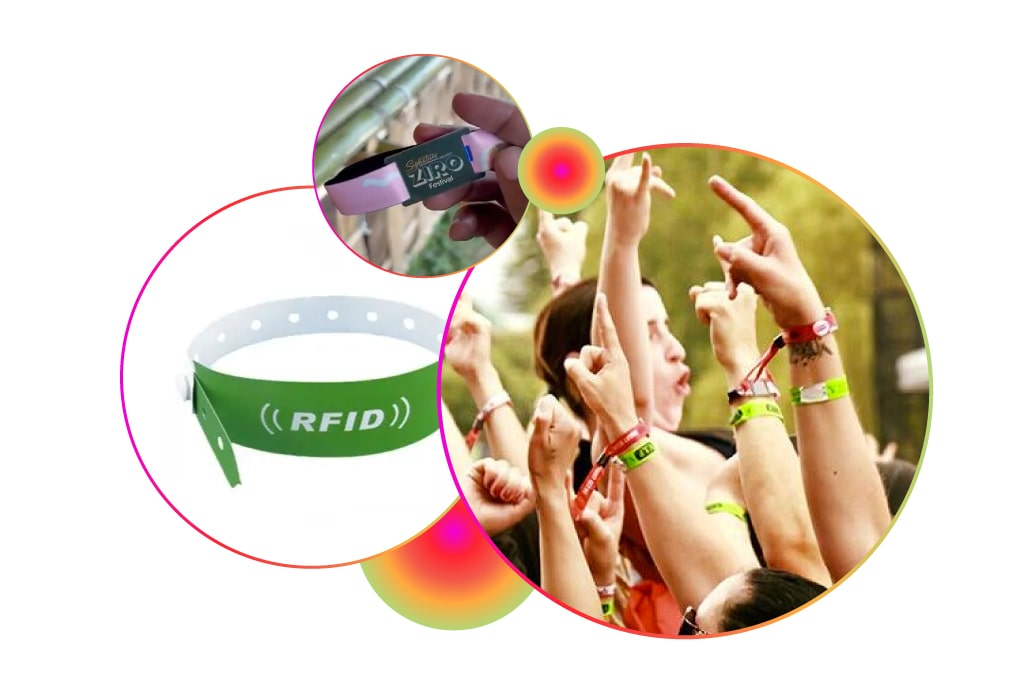
What exactly does RFID stand for?
RFID stands for Radio Frequency Identification. In the context of modern event management, it is essentially a digital replacement for the traditional paper ticket or barcode. Instead of a staff member manually hunting for a name on a printed spreadsheet or aiming a laser pointer at a crumpled piece of paper, RFID uses low-power radio waves to transmit data.
Within the broader event management framework, the service segment for registration, ticketing, and attendee management is expected to grow at the fastest CAGR of 8.0%, as organizers actively seek advanced systems to manage high volumes of live participants. For event organizers, RFID transforms attendees’ credentials, whether it’s a high-end badge or a fabric festival wristband, into a smart, wearable digital passport.
Also Read: From 500 to 5 Lakh Attendees: How Dreamcast Delivers at Scale
How does RFID work in Event Tech?
The entire system relies on a continuous, ultra-fast conversation between two primary pieces of hardware: the tag (embedded in the attendee’s badge) and the reader (the scanning device, gate, or kiosk).

The magic happens in three lightning-fast steps:
- The Broadcast: The RFID reader continuously emits a localized radio-frequency field.
- The Activation: When an attendee walks up or taps their badge, the radio waves wake up the tiny chip inside the badge.
- The Handshake: The chip beams its unique identification number back to the reader, which checks it against your registration database and flashes green, all in a fraction of a second.
Read more about: Introducing Fastest Indian, the Dreamcast Badge Kiosk: 10-Second Badge Process, Now a Reality!
Why is RFID different from traditional barcodes or QR codes?
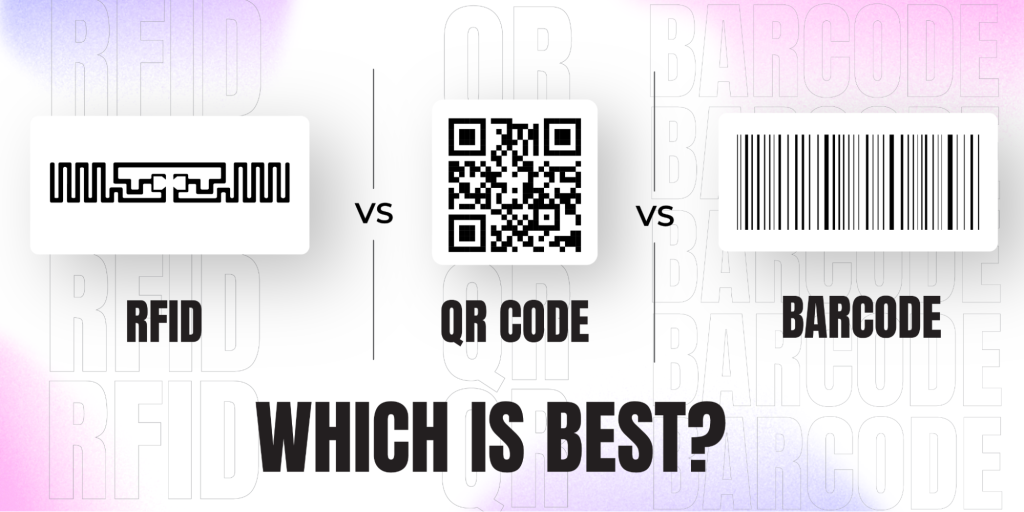
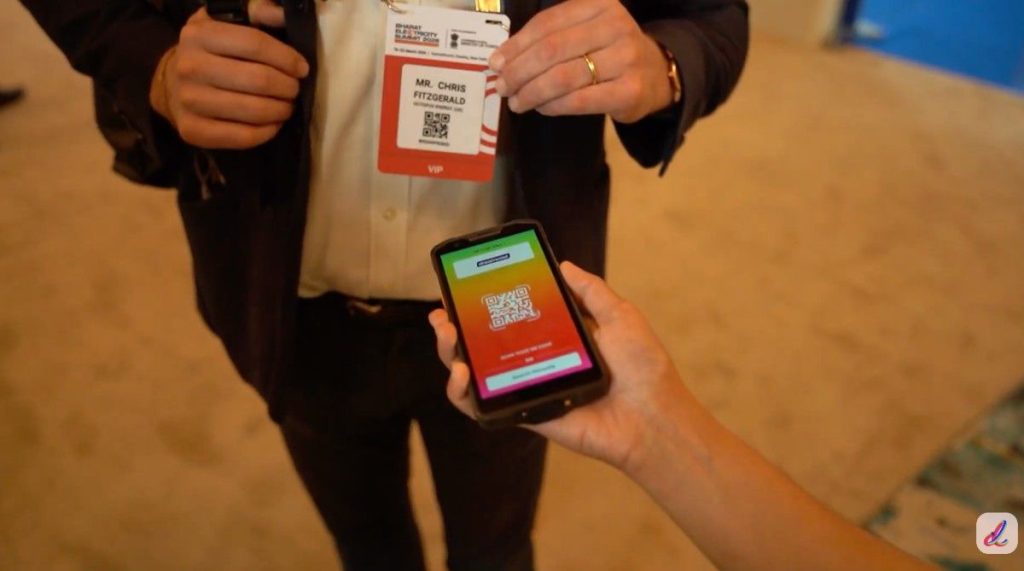
Standard QR codes have a massive drawback, which is line of sight. To scan a QR code, your staff must physically align a phone camera or laser scanner perfectly with a screen or paper badge. If the attendee’s phone screen is cracked, dimmed, or covered in glare, or if their paper badge is flipped backward around their neck, the line slows to a crawl.
Did you know that over 65% of large enterprise event budgets are now officially allocated to digital engagement tools and data analytics modules to measure attendee patterns accurately?
RFID makes the process very easy. Attendees do not need to fumble with their phones or wait for a camera to focus. They simply walk past a scanner or tap and go, cutting check-in times down to mere seconds. Here is the table stating some major differences between RFID and QR code-based entry systems:
| Feature | RFID Entry Systems | QR Code Entry Systems |
| Scanning Speed | Very-Fast (< 2 seconds per person). No line-of-sight required. | Slower (5–10 seconds per person). Requires physical alignment with a camera. |
| Crowd Management | Excellent. Best for high-volume crowds (500 to 50,000+) to prevent entrance bottlenecks. | Moderate. Best for smaller crowds (< 500) or staggered arrival windows. |
| Line-of-Sight Needed? | No. Scans through clothing, bags, or if the badge flips backward around the neck. | Yes. The screen or paper must be flat, clean, and facing the camera directly. |
| Physical Form Factor | Embedded in fabric wristbands, premium plastic badges, or smart stickers. | Displayed on a smartphone screen, a printed email, or a paper badge. |
| Security & Fraud Prevention | Very High. Chips are encrypted and virtually impossible to duplicate or screenshot. | Low. Attendees can easily screenshot and text their QR code to unauthorized guests. |
| In-Event Tracking | Advanced. Passively tracks session attendance, zoning, and heatmaps as guests walk by. | Basic. Requires active, manual scanning at every single interior door. |
| Hardware Costs | Higher. Requires specialized RFID readers, encoders, and embedded chip materials. | Lower. Can be scanned using standard smartphones, tablets, or basic laser scanners. |
| Data Recovery Offline | Excellent. Enterprise systems (like Dreamcast) cache data locally on-site if Wi-Fi drops. | Varies. App-based scanners frequently freeze or lag if the venue Wi-Fi becomes spotty. |
Why Scalability Is the Biggest Challenge in Event Check-In
According to Congruence Market Insights, approximately 47% of event planners have integrated smart data tracking modules to analyze spatial attendee behavior, resulting in an average 15% uplift in session conversion rates.
Knowing all your options to manage registrations is for the best. But before discussing the solution, you must know the pain points. You must know the real issues in scaling to more than 50,000 attendees.
The Problems Events Face as Attendance Grows
Longer queues
Long wait times are often the first visible sign that an event’s check-in process cannot handle attendee volume. When hundreds or thousands of attendees arrive within a short timeframe, registration desks can quickly become overwhelmed. Even a delay of a few seconds per attendee can result in queues stretching across venue entrances. Longer queues create several problems:
- Poor first impressions
- Attendee frustration
- Increased support requests
- Higher staffing pressure
- Reduced attendee satisfaction
For many attendees, the check-in experience shapes their perception of the entire event.
Entry bottlenecks
Large events typically experience crowded arrival periods, especially before keynote sessions, opening ceremonies, or popular workshops. When attendee inflow exceeds processing capacity, bottlenecks are more likely to form at:
- Registration counters
- Badge collection points
- Security checkpoints
- Venue entrances
These bottlenecks can disrupt attendee movement and create operational challenges throughout the venue.
Staff dependency
Traditional check-in processes often rely heavily on event staff to verify registrations, print badges, answer attendee questions, and manage entry issues. As the number of attendees grows, organizers frequently respond by adding more personnel.
However, increasing staff numbers does not always solve scalability challenges. Larger teams require:
- Additional training
- More coordination
- Greater operational oversight
- Higher labor costs
This creates a linear increase in cost that becomes difficult to sustain at large events.
Delayed session starts
Check-in delays frequently impact event schedules. When a significant number of attendees remain stuck in entry queues, organizers often face pressure to delay activities, like opening ceremonies, keynote presentations, breakout sessions, and workshops. These delays can affect speaker schedules, venue operations, and the overall attendee experience.
Network overload
Many modern check-in systems depend on internet connectivity for attendee verification and registration validation. During peak arrival periods, thousands of devices may simultaneously access venue networks. This can result in:
- Slower attendee verification
- System timeouts
- Delayed badge printing
- Check-in interruptions
Without scalable infrastructure, network performance can become a critical failure point.
Security and verification issues
As event size increases, maintaining security becomes more challenging. Organizers must ensure that only authorized attendees gain entry, duplicate registrations are identified, counterfeit badges are prevented, and access permissions are properly enforced.
Large crowds combined with manual verification processes can increase the risk of errors and unauthorized access.
Why Traditional Check-In Systems Fail at Scale
Did you know that event ticketing platforms handled over 270 million total tickets across 4.7 million separate events, underscoring the sheer volume of arrivals that must be processed electronically without manual paper checklists?
Many event organizers continue to rely on check-in methods that were originally designed for smaller gatherings. While these approaches may work for low-volume events, they often struggle when attendee numbers reach the thousands.
The fundamental issue is that traditional systems were not built for the speed, accuracy, and scalability required by modern events.
Manual Check-In Limitations
Manual attendee verification is one of the biggest obstacles to efficient event entry. In a manual process, staff typically search attendee records, verify registration details, confirm identity, mark attendance, and distribute badges.
Even when performed efficiently, this process takes significantly longer than automated alternatives. Manual systems also become increasingly difficult to manage as attendee databases grow larger. Common issues include:
- Slow record searches
- Data entry mistakes
- Duplicate check-ins
- Misplaced attendee records
The result is slower throughput and a higher likelihood of operational disruptions.
QR/Barcode Scanning Bottlenecks
QR code and barcode technology significantly improved event check-in efficiency, but not all implementations are equally scalable. Many events still experience bottlenecks because of:
- Limited scanning stations
- Insufficient scanning devices
- Poor scanner performance
- Weak internet connectivity
- Badge printing delays after scanning
When thousands of attendees arrive simultaneously, even fast scanning systems can become congested if supporting infrastructure is not designed for high-volume processing. Simply adding QR codes does not automatically solve scalability challenges.
Human Error During Peak Entry Hours
High-volume arrival periods place significant pressure on event staff. As workloads increase, the likelihood of human error also rises. Common examples include incorrect attendee verification, duplicate badge printing, wrong access assignments, misspelled attendee information, and missed registrations.
These errors often require manual intervention, which further slows the check-in process and creates additional queues.
At large-scale events, even a small percentage of verification errors can impact hundreds of attendees and significantly affect operational efficiency.
How RFID Event Check-In Handles Massive Scalability
Scalability is one of the biggest reasons large conferences, exhibitions, trade shows, and sporting events are increasingly adopting RFID event check-in systems.
Unlike traditional check-in methods that process attendees individually, RFID technology is designed to handle high-volume attendee flows with minimal friction. Whether an event welcomes 5000 attendees or 50,000, RFID enables organizers to maintain speed, accuracy, and operational efficiency without proportionally increasing staff or infrastructure.
1. Simultaneous Attendee Processing
One of RFID’s greatest advantages is its ability to process multiple attendees at the same time. Traditional check-in methods typically require each attendee to stop, present a ticket, and wait for verification. This creates a sequential process where attendees are processed one after another.
RFID works differently
As attendees carrying RFID-enabled badges or wristbands pass through a reader’s detection zone, their credentials are automatically identified and verified within seconds.
No line-of-sight scanning required
Unlike QR codes or barcodes, RFID does not require attendees to open an app, search for a ticket, present a badge to a scanner, and position the code correctly.
The RFID reader detects tags automatically, even when badges remain inside pockets, lanyards, or bags.
Faster throughput at entry gates
Because attendees do not need to stop for individual verification, entry gates can process significantly more people within the same timeframe.
Example:
| Check-In Method | Processing Style | Typical Throughput |
| QR Code Scanning | One attendee at a time | Limited by individual scans |
| RFID Check-In | Multiple attendees simultaneously | Hundreds of validations per minute |
This ability to verify multiple attendees simultaneously makes RFID particularly valuable for large-scale events where thousands of attendees arrive within a short period.
2. Faster Entry Flow Reduces Queue Congestion
Long queues are one of the most common complaints at conferences and exhibitions. Queue congestion occurs when attendee arrival rates exceed check-in processing capacity.
RFID helps solve this problem by dramatically reducing the time required for attendee verification. Instead of stopping attendees at entry points, RFID enables a continuous flow of movement through gates and access points.
Benefits of Faster Entry Flow
- Reduced waiting times
- Improved attendee satisfaction
- Faster venue access
- Less crowding at entrances
- Better first impressions
For event organizers, this means fewer operational disruptions and a more positive attendee experience from the moment participants arrive.
Why Queue Reduction Matters
At large events, even a five-second reduction in check-in time per attendee can translate into hours of cumulative time savings across the attendee population.
The result is smoother event operations and improved venue traffic management.
3. Multi-Gate Scalability for Large Venues
Large conferences and exhibitions rarely rely on a single entrance. Attendees often enter through multiple gates, halls, registration areas, and access checkpoints. RFID systems are designed to scale across these environments.
RFID Supports Parallel Check-In Operations
Instead of routing everyone through one verification point, organizers can deploy RFID readers across multiple entry locations.
This allows multiple entry points, simultaneous attendee validation, reduced crowd concentration, and faster venue access.
Multiple entry points
Instead of routing everyone through one verification point, organizers can deploy RFID readers across multiple entry locations. This allows:
- Multiple entry points
- Simultaneous attendee validation
- Reduced crowd concentration
- Faster venue access
Zone-based access
Large events often require different access permissions for attendees, speakers, sponsors, exhibitors, VIP guests, and staff members.
RFID systems can automatically verify access rights and grant entry to authorized zones without requiring manual checks.
Distributed attendee validation
For multi-building events, RFID readers can operate across:
- Conference halls
- Exhibition floors
- VIP lounges
- Workshop areas
- Networking zones
This creates a scalable access management system capable of supporting complex event environments.
4. Real-Time Data Synchronization Across Venues
Managing attendee data across multiple venues or event spaces becomes increasingly challenging as event size grows.
Traditional systems often struggle with synchronization delays and inconsistent attendee records. RFID systems solve this challenge through centralized data management.
Centralized Attendee Database
All RFID scans connect to a unified attendee database that stores registration information, access permissions, check-in status, and attendance history.
This ensures every access point works from the same attendee data source.
Instant attendee verification
As soon as an RFID tag is detected:
- Attendee credentials are verified
- Access permissions are checked
- Entry status is updated
The process occurs in real time.
Real-time updates across all gates
If an attendee enters through one gate, the system immediately updates across all connected checkpoints. This prevents inconsistencies and improves operational visibility.
Scalability Advantage
Real-time synchronization enables:
- No duplicate check-ins
- Accurate live attendee counts
- Faster crowd management decisions
- Improved venue utilization tracking
- Seamless operation across multiple halls or venues
For large-scale events, this visibility becomes essential for maintaining control and optimizing attendee flow.
5. Reduced Staffing Requirements at Scale
Traditional event check-in systems often require organizers to increase staffing levels as attendance grows. More attendees typically mean:
- More registration desks
- More verification personnel
- More queue management staff
- More troubleshooting resources
RFID changes this equation through automation.
Automation Replaces Manual Verification
RFID readers automatically verify attendee credentials without requiring staff to manually search databases or inspect tickets. This significantly reduces operational workload.
Less dependency on large check-in teams
Because attendee validation happens automatically, organizers can operate with smaller entry teams while maintaining efficient throughput.
Staff can focus on guest assistance, issue resolution, VIP management, and event operations. Instead of repetitive check-in tasks.
Business Benefits of Reduced Staffing
RFID scalability delivers measurable operational benefits:
- Lower manpower costs
- Faster attendee movement
- Reduced training requirements
- Easier event coordination
- Faster issue resolution
- Improved operational efficiency
As event attendance grows, these efficiencies become increasingly valuable, allowing organizers to scale events without proportionally increasing operational complexity.
How RFID Prevents System Failure During Peak Crowd Hours
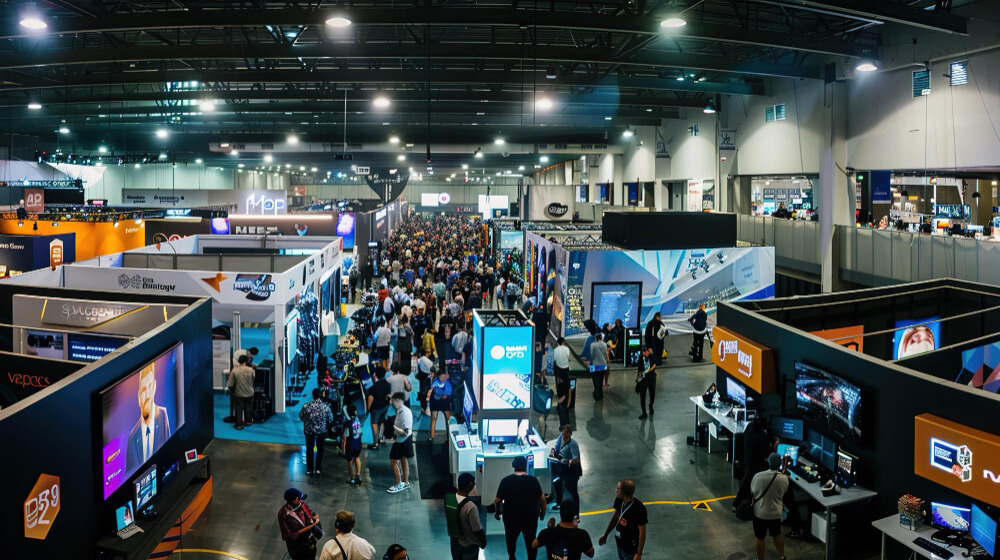
Large events often experience sudden surges in attendee arrivals before keynote sessions, opening ceremonies, or major networking activities. RFID technology helps prevent system overload by automating attendee verification, distributing traffic efficiently, and providing real-time visibility across all check-in points.
Load Distribution Across Check-In Points
RFID enables attendees to be processed across multiple entry gates simultaneously rather than relying on a single check-in location. This distributes crowd volume more evenly, reduces congestion, and prevents bottlenecks during peak arrival periods.
Instant Badge Authentication
RFID readers automatically verify attendee credentials the moment an RFID badge or wristband enters the reader’s range. This eliminates manual verification delays and keeps attendee traffic moving smoothly through entry points.
Automated Duplicate Detection
The system instantly recognizes if a badge has already been used for entry, helping prevent duplicate check-ins and unauthorized access. This improves security while ensuring accurate attendance tracking throughout the event.
Real-Time Monitoring & Alerts
RFID platforms provide live visibility into attendee movement, gate activity, and crowd density. Organizers can receive instant alerts about congestion, unusual activity, or operational issues, allowing them to take corrective action before problems escalate.

Also Read: Is Face Recognition Reliable for Managing 50,000 to 1 Lakh+ Attendee Event Check-in?
What Crucial Questions Must You Ask An Event Tech Partner?
Selecting the right technology provider is the single most critical decision in your RFID journey. On paper, every vendor promises a flawless event, but a live event floor is an unpredictable environment.
To protect your investment and sanity, you need to look past the marketing gloss and interview potential hardware vendors with strict, practical questions.
What happens to the check-in system if the venue’s internet crashes?
This is the ultimate stress test for any event technology. If a vendor’s software relies entirely on a continuous cloud connection to validate credentials, a sudden venue internet blackout will freeze your gates instantly.
You need a vendor whose hardware operates on a local-first architecture. This means the scanners store a fully synchronized copy of the attendee database directly on their internal memory or an on-site local server.
If the internet drops, the system continues to scan badges, grant entry, and record timestamps without skipping a single beat, automatically pushing the cached data back to the cloud the moment the connection returns.
Are there hidden fees for custom branding, shipping, or hardware rentals?
No matter how much you emphasize online pre-registration, people will show up at the venue door wanting to buy a ticket on the spot. If your vendor requires badges to be pre-programmed in massive batches days in advance, handling spontaneous walk-ups becomes an administrative nightmare.
Ask your vendor exactly how their system handles on-demand registration. The ideal setup involves a smooth integration between the ticket sales terminal and a live RFID desk encoder. Within five seconds of a walk-up payment clearing, a fresh badge should be printed, and the local scanner should instantly recognize the newly embedded chip.
What level of on-site technical support is included in the contract?
Line-item surprises can quickly derail an event budget. A low initial quote for software or basic hardware rental often hides a mountain of downstream logistics costs.
Always ask for a transparent, bottom-line financial breakdown, such as:
- Does the quote include the manufacturing and custom full-color printing of your badges or fabric wristbands?
- Who covers the expensive overnight shipping for heavy scanning kiosks or turnstiles?
- Are you responsible for packing and shipping the hardware back to their warehouse the day after the event, or do they provide pre-paid return labels and cases?
Clarifying these points early protects you from unexpected, post-event invoices.
How quickly can a last-minute walk-up registration get their RFID tag?
Remote tech support via phone, WhatsApp, or Slack is rarely sufficient when thousands of people are pushing through your entry gates, and a reader stops responding. You cannot afford to play phone tag with an engineer while your queue backs up into the street. For any event crossing the 500-attendee mark, ask exactly how many of the vendor’s specialized technicians will be physically present on-site.
You want at least one dedicated hardware lead at the main gate during peak check-in hours to monitor network stability, manage device battery swaps, and immediately troubleshoot any hardware anomalies before they turn into real bottlenecks.
How Can Dreamcast Transform Your Next Event Into a Success Story?
When scaling an event from hundreds to tens of thousands of attendees, you cannot afford to rely on guesswork or brittle systems. This is where Dreamcast comes in. As an industry-leading event tech solution provider, Dreamcast has built an end-to-end ecosystem engineered to address the chaos of high live footfall, delivering an enterprise-grade check-in experience.
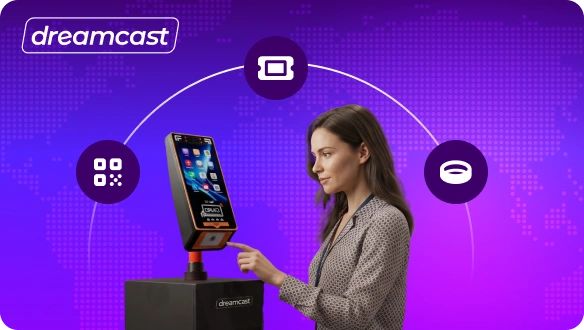
Attendees simply approach a kiosk, complete their check-in flow in a couple of taps, or step up to an integrated RFID turnstile gate. The radio frequency handshake occurs instantly, releasing the gate barrier and checking the attendee into the event master database in under 10 seconds.
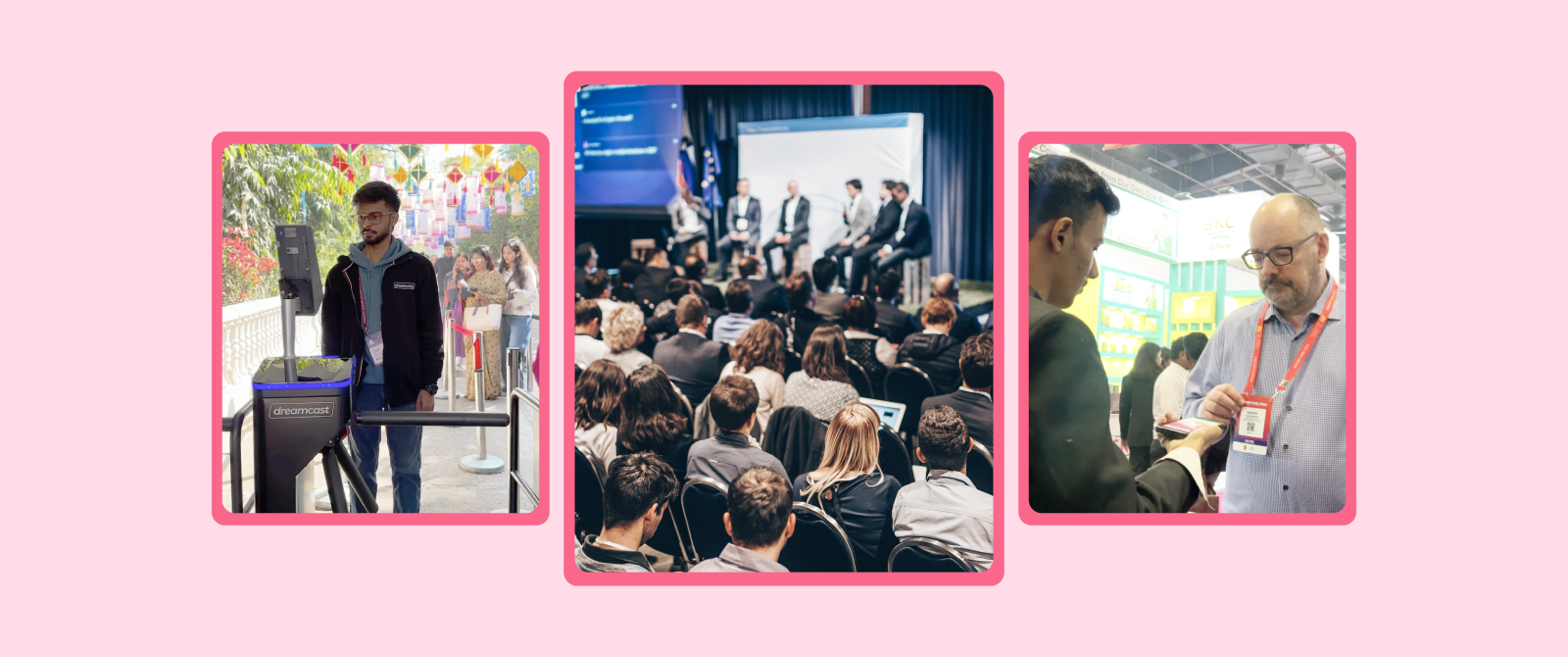
Pre-printing thousands of badges before an event is an operational trap that leads to significant material waste, frantic alphabetical searches, and long wait times. Dreamcast completely transforms this workflow with its robust on-demand badge printing solutions and access management system, as it did for Startup Mahakumbh 2025.
Read more: Dreamcast’s Event Tech at Startup Mahakumbh 2025
Wrapping Up
Finally, we can say that upgrading to a modern, robust RFID check-in system eliminates human error, secures premium areas, and generates invaluable crowd insights. Also, you can leverage it for future events.
By partnering with an experienced event registration partner like Dreamcast, you gain access to high-speed turnstiles, instant on-demand badging, and local server backups that shield your gates from unpredictable venue internet crashes. Investing in the right technology does not just eliminate queue friction; it turns your event arrivals into a seamless, high-end experience from the very first tap.
FAQs
Standard handheld scanners require no extra room, but automated kiosks or turnstiles require a structured entry zone roughly 15 to 20 feet deep to prevent foot traffic from bottlenecking.
For pre-printed badges, send your list 7 to 10 days out; however, with Dreamcast’s on-demand printing kiosks, you can sync data live and accommodate walk-ups up to the very last second.
None. Passive RFID chips are entirely safe, emit no constant signal, and do not store sensitive personal information, only an encrypted ID code that syncs securely with your private database.
Direct them to a dedicated “Troubleshooting Desk” off to the side so staff can look up their profile and issue a quick replacement without slowing down your main entry lanes.
Unlike pure software platforms that surprise you with hidden add-on hardware rentals and processing fees, Dreamcast provides an all-inclusive, transparent pricing model that bundles premium RFID hardware, on-demand printing kiosks, and native WhatsApp automation into the core solution.
Dreamcast’s ecosystem is built for massive concurrency, meaning its architecture effortlessly scales up from single-digit scanning desks to dozens of connected turnstiles, handling hundreds of thousands of live footfalls without any system lag.