 Event Core
 Phygital Events
 Event Apps & Platform
 On-site Solution





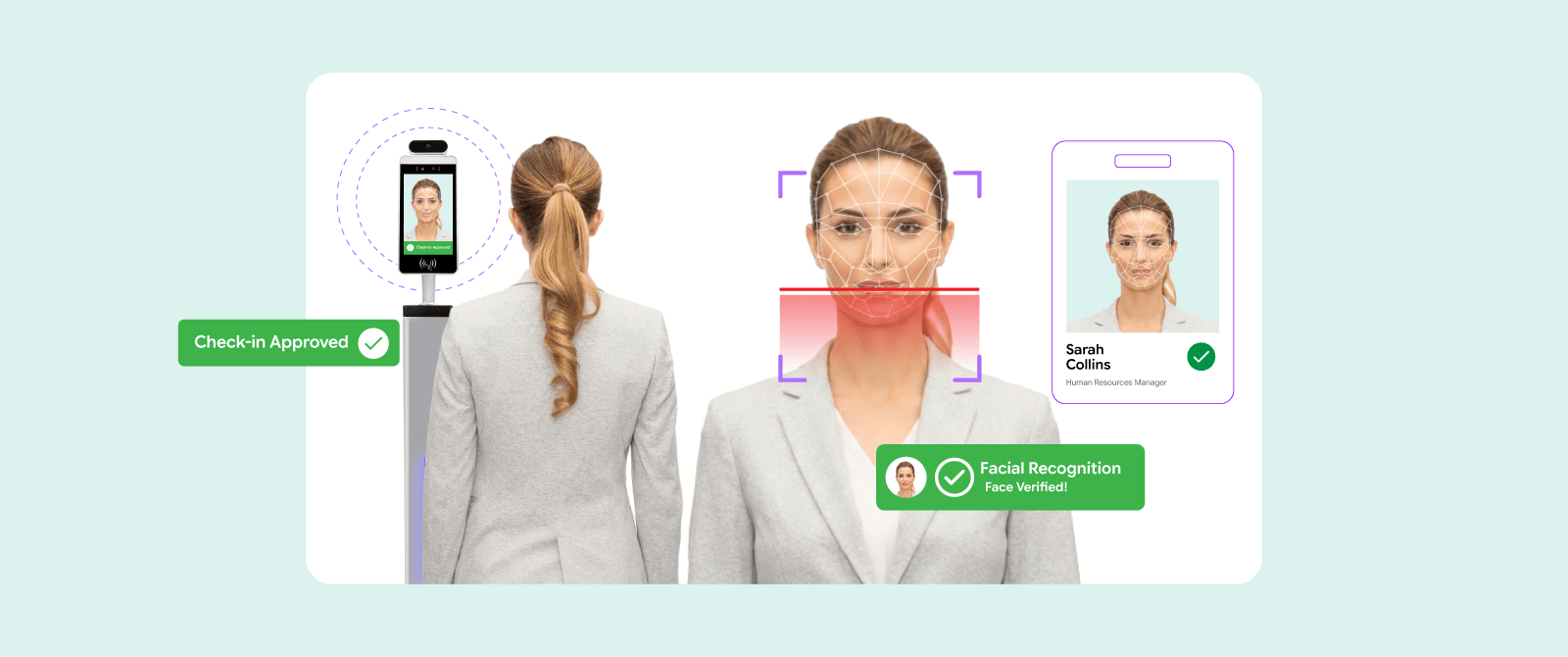

Table of Contents
Yes, modern face recognition event check-in systems can reliably manage 50,000 to 1 lakh+ attendees when the setup is done correctly. Advanced AI-powered event check-in systems now process attendees within 10 seconds while maintaining facial recognition accuracy rates as high as 99%. Large conferences, expos, concerts, and corporate events are increasingly using facial recognition for events to reduce queues, improve security, and create a faster entry experience. The results depend heavily on registration quality, camera setup, internet stability, and the event technology provider managing the operation.
Key Takeaways- 1. Facial recognition event check-in can reduce attendee verification time to under 10 seconds per person.
- 2. Modern facial recognition for events can achieve 97% to 99% accuracy under proper lighting and setup conditions.
- 3. Large-scale events with 50,000+ attendees often use AI event check-in systems to reduce queue congestion during peak hours.
- 4. Face recognition attendance systems help lower duplicate entry risks and badge misuse.
- 5. Contactless event entry improves attendee flow at conferences, expos, and concerts.
- 6. Multi-gate facial recognition systems can process thousands of attendees per hour simultaneously.
- 7. Real-time analytics and crowd monitoring help organizers manage high-density entry points more efficiently.
Modern facial recognition for events is now being used to manage high-volume attendee check-ins at conferences, expos, concerts, trade shows, and corporate summits where speed and crowd movement matter heavily.
“Do you have a FR (Face Recognition) Check-in System? How do you use it, and what is its accuracy?” This has become one of the most common questions among organizers planning large-scale events.
The reason is simple. Traditional check-in methods often struggle during peak entry hours. Manual verification slows down gates, while QR code scanning still creates delays when attendees search for emails or face network issues. Facial recognition for events helps reduce these problems by enabling fast, contactless attendee verification within seconds while improving event access control and large-scale crowd management.
Modern AI-powered event check-in systems improve attendee flow, reduce duplicate entry risks, strengthen event access control, and support large-scale crowd management across multiple entry points.
Table of Contents
What Is Facial Recognition Event Check-in and How Does It Work?
Facial recognition event check-in is a contactless entry system that uses artificial intelligence (AI) to verify attendees through their facial features at venue entry points. Instead of presenting printed tickets, QR codes, or OTPs, attendees can use their faces as their check-in credentials, enabling faster and more secure event access.
It is now widely used at large-scale events where organizers need faster attendee verification and better crowd management.
The main reason behind the growth of facial recognition for events is speed. Large-scale events often struggle with long queues during peak entry hours. If an attendee’s name is straightforward and they have their ID ready, a typical manual lookup takes around 30-40 seconds
On the other hand, advanced enterprise event technology frameworks utilize localized hardware paired with AI camera terminals to complete verification and matching within 10 seconds. In simple words, AI-powered event check-in systems help reduce waiting time while improving event access control and attendee flow.
Read more: Zero-Queue Event: Achieve 10-Second Check-In with Kiosks, Turnstiles & AI
Event Check-in Method Comparison
The primary catalyst driving biometric check-in system adoption in the event management industry is operational velocity. Traditional check-in setups create predictable bottlenecks during peak morning arrival hours because human processing speeds are inherently limited.
| Check-In Method | Average Processing Speed | Primary Operational Bottleneck |
| Traditional Manual Lookup | 30 to 40 seconds per person | Staff typos, spelling confusion, and missing physical IDs |
| Standard QR Code Scanning | 15-20 seconds per person | Phone battery issues, low screen brightness, and slow loading |
| AI Facial Recognition Gateways | Under 10 seconds per person | Non-optimized pre-event photo uploads |
Step-by-Step: How Does a Biometric Event Check-In System Process Attendees?
Here is how a facial recognition event check-in system usually works, step by step:
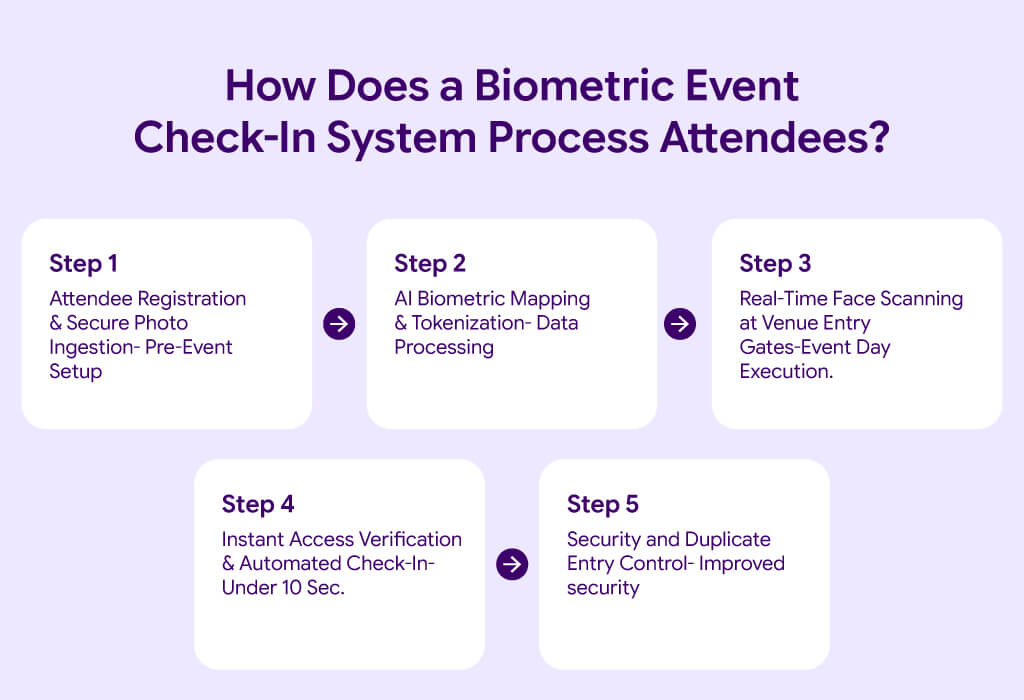
Step 1: Attendee Registration & Secure Photo Ingestion- Pre-Event Setup
The process begins within the event registration platform.
Attendees upload a clear photograph or take a live selfie while registering for the event. The event registration platforms, such as Dreamcast, store photos in an encrypted, cloud-based database.
Note:- The quality of this image matters because the system uses it later for face matching during check-in.
For example, if an attendee uploads a blurry side-angle image, the facial recognition accuracy may decrease during live entry verification.
Step 2: AI Biometric Mapping & Tokenization- Data Processing
After registration and once an image is captured, the underlying facial recognition software analyzes distinct geometric landmarks. The AI algorithm calculates structural facial proportions, including
- Eye distance
- Nose structure
- Face shape
- Jawline pattern
- Facial proportions
This process is often called facial mapping.
Instead of storing only a normal photo, the system creates a mathematical face profile that helps the AI-powered event check-in system recognize attendees quickly and accurately.
Step 3: Real-Time Face Scanning at Venue Entry Gates-Event Day Execution.
On the day of the event, high-speed check-in terminals with cameras, self-service biometric kiosks, or integrated turnstiles are positioned at entry gates. As an attendee approaches the threshold, the camera captures a live scan in milliseconds and cross-references the mathematical token against the pre-registered attendee database.
That speed becomes extremely important at enterprise-level events.
Step 4: Instant Access Verification & Automated Check-In- Under 10 Sec.
If the live facial token matches the registration database profile, the entry gateway triggers instantaneous validation, opening the automated physical turnstile.
Simultaneously, this local transaction updates the master event dashboard in real-time. This instantaneous sync allows event operations teams to track aggregate live data across the entire venue footprint, including:
- Total Attendee Check-ins: Monitor live conversion rates against total registrations.
- Gate-Wise Crowd Movement: Identify high-traffic entry points to optimize on-site staff positioning.
- VIP & Delegate Arrivals: Trigger automated backend alerts for immediate, high-touch hospitality.
- Duplicate Entry Attempts: Instantly flag and isolate credentials scanned multiple times at different gates.
- Real-Time Attendance & Session Data: Track exact participation metrics across individual breakout rooms and main stages.
Step 5: Security and Duplicate Entry Control- Improved security
What is the greatest advantage of an AI-enabled FR check-in system for events? The short answer isthat it also improves security management.
So, how does facial recognition prevent ticket fraud and pass-sharing?
Throughout live operations, the AI engine enforces strict perimeter security. Because facial tokens are non-transferable, the system completely prevents common event security vulnerabilities such as
- Pass-sharing,
- Ticket duplication,
- Unauthorized entry
- And badge fraud.
Advanced enterprise-grade setups utilize liveness detection (anti-spoofing technology) to identify and reject printed photos or digital screen replays attempting unauthorized entry.
Read More: 10 Surprising Benefits of Using Facial Recognition at Events (Beyond Speed)
What Technologies Power an AI-Based Face Recognition Check-in System?
Modern facial recognition event check-in systems combine edge hardware, deep learning algorithms, and real-time data sync networks to deliver secure attendee verification under 10 seconds. The underlying technology stack consists of three core architectural layers:
What are the key components and core functions of FR check-in technology?
| Technology Layer | Key Components | Core Function |
| 1. Computer Vision & Machine Learning Algorithms | Convolutional Neural Networks (CNNs), Biometric Mapping & Tokenization | Isolates human targets from background noise, maps facial geometry, and instantly encrypts data into secure tokens. |
| 2. Edge Hardware & Local Computing | Smart Gateways, Biometric Kiosks & On-Site Local Edge Servers | Captures live video frames and processes matches locally at the venue to ensure zero-latency entry even if Wi-Fi drops. |
| 3. Unified Event Ecosystem Integrations | Secure APIs, Registration Sync, Thermal Printers & Dashboards | Connects biometric gates directly to central ticketing databases (such as Dreamcast), on-demand badge printers, and live organizer dashboards. |
1. Computer Vision & Machine Learning Algorithms
The mathematical engine behind biometric processing relies on highly advanced artificial intelligence models designed to process visual inputs instantly:
- Convolutional Neural Networks (CNNs): These deep learning architectures act as the primary framework for image parsing. According to computer vision research documented by the IEEE Xplore Digital Library, CNNs excel at filtering complex background environments (like busy event venues) to isolate and analyze specific human targets.
- Biometric Facial Mapping: The software analyzes key spatial coordinates on the human face- such as the distance between the pupils, the width of the nasal structure, and jawline curvature.
- Cryptographic Tokenization: To ensure strict compliance with international data privacy frameworks like the European Union’s General Data Protection Regulation (GDPR), modern frameworks instantly convert raw facial images into encrypted mathematical strings (tokens). The original image is discarded, making the system completely secure against identity theft.
2. Edge Hardware & Local Computing
To guarantee sub-10-second processing times, enterprise platforms deploy a specialized physical hardware layer directly on-site:
- Smart Biometric Gateways: High-definition optical camera terminals, automated turnstiles, or integrated check-in kiosks capture live video frames in milliseconds.
- Local Edge Servers: By running the matching algorithm on a localized on-site server, the system completes verification locally, ensuring 100% uptime even if the venue’s primary internet connection fails.
3. Unified Event Ecosystem Integrations
To manage high-volume attendee movement efficiently during mega events, the face recognition attendance platform, such as Dreamcast, integrates directly with the broader event operations stack via secure APIs:
- Event Registration Software: Instantly pulls reference profiles from the database (such as Dreamcast) to update the gate hardware.
- On-Demand Badge Printing Systems: Triggers high-speed printers to instantly output a customized badge when the face match is approved.
- Centralized Event Management Dashboards: Feeds live check-in data to organizers for real-time crowd monitoring and capacity tracking.
Can Face Recognition Really Handle 50,000 to 1 Lakh+ Attendees?
The short answer is yes. However, executing biometric access control at this magnitude requires fast and cloud-dependent software solutions. When a music festival, stadium concert, or mega-expo caters to more than 50,000 attendees, a single second of latency can cause massive, hazardous queue lines at the outer gates.
Managing 1 Lakh+ attendees smoothly relies on specific operational engineering protocols that ensure speed, stability, and throughput consistency.
The Three Pillars of Mega-Event Scalability
To prevent system lag during the peak morning arrival rush of a major conference or expo, enterprise systems such as Dreamcast rely on a three-tiered cloud and hardware strategy:
1. High-Speed Cloud Sync & Real-Time Database Querying
For the system to process masses of attendees smoothly, the cloud architecture must be built for maximum performance.
- The Mechanic: When an attendee approaches a check-in terminal, the live face scan is instantly tokenized and securely sent to a high-availability cloud database hosting the 1 Lakh+ attendee records.
- The Scalability Result: By utilizing premium cloud infrastructure (such as AWS or Google Cloud servers) with dedicated web-socket connections, the system executes real-time data lookups in milliseconds. Even with thousands of concurrent scans across multiple gates, the system retrieves validation statuses over the internet without delay.
2. Multi-Threaded Concurrency & Database Indexing
Searching a database of 100,000+ active profiles simultaneously across dozens of separate entry lanes requires massive algorithmic efficiency to avoid server timeouts.
- The Mechanic: The cloud engine utilizes multi-threaded processing and optimized biometric indexing. Instead of scanning all 100,000 records one by one, the AI algorithm groups the facial tokens into indexed mathematical clusters based on primary geometric characteristics.
- The Scalability Result: The cloud search is limited to a highly specific index subset, dropping the digital verification loop to a fraction of a second. This leaves the entire entry process, from step-up to confirmation, taking less than 10 seconds per person.
3. Dedicated Network Load Balancing & High-Throughput Hardware
When a massive crowd gathers in one geographic footprint, cellular networks slow down, making dedicated venue network planning a non-negotiable step.
- The Mechanic: Organizers set up dedicated, high-bandwidth internet lines exclusively for the entry gateways. The terminal hardware- whether AI-powered kiosk or integrated electronic turnstiles- is directly paired with a high-performing internet connection that evenly distributes data traffic across cloud server instances.
- The Scalability Result: This creates a continuous, high-volume assembly line. The attendee steps up, the camera shoots, the cloud data verifies over the active connection, and the gate unlocks automatically. This eliminates manual staff intervention and keeps crowd movement completely fluid.
Check-in system delployment Calculation (For an Example)
To understand how enterprise event infrastructure handles immense crowd pressure, let’s look at a practical deployment blueprint. Suppose you are executing a massive 2-day event with an aggregate footprint of 100,000 anticipated attendees.
To prevent dangerous gate bottlenecks, your entry setup must be precisely engineered around peak crowd arrival dynamics and system processing capabilities.
The Core Operational Parameters
- Total Attendance: 100,000 people over a 2-Day Event
- Daily Attendance Load: 50,000 people per day
- Peak Arrival Window: 3 Hours per day (Statistically, 70% of that day’s crowd arrives in this compressed rush hour)
- Target Processing Speed: 5 Seconds per person
- Available Entry Locations: 5 Separate Venue Gates
Step-by-Step Capacity Calculation
Step 1: Determine the Peak Flow Target
First, we isolate the exact number of attendees the system must process per hour during the absolute highest-density surge period on Day 1 or Day 2.
Daily peak volume (70% of 50k) = 50,000 x 0.70 = 35,000 Attendees
Required Ingress velocity = 35000 attendees/ 3 hours= 11.667 attendees/ hours
Step 2: Calculate Single Lane Output
With an optimized cloud-sync system processing an identity match in 5 seconds, a single lane handles exactly 12 people per minute.
Hourly capacity per lane= 12 people/min x 60 minutes= 720 attendees/ hours
Step 3: Calculate Total Required Entry Lanes
To clear the 11,667 hourly rush using lanes capable of processing 720 people per hour:
Total Lane Needed = 11,667 attendees/hours/ 720 attendees/ lane/ hours = 16 Lanes Approx
Note:- To account for sudden crowd surges, we round this figure up to a standard, balanced configuration of 20 total automated lanes.
By taking your 20 required lanes and distributing them evenly across your 5 venue entry points, you create a highly efficient terminal architecture:
Lane per entry points = 20 Lane/ 5 Entry Point = 4 Lanes per gate.
By deploying 4 high-speed lanes at each of your 5 gates, your entire venue achieves a combined maximum capacity of 14,400 people per hour. This safely outpaces the peak daily surge requirement of 11,667 people, ensuring a premium, zero-wait entry experience for a crowd of 1 Lakh spread over two days
Real-World Proof: The Ultimate Scalability Test at #JLF 2026
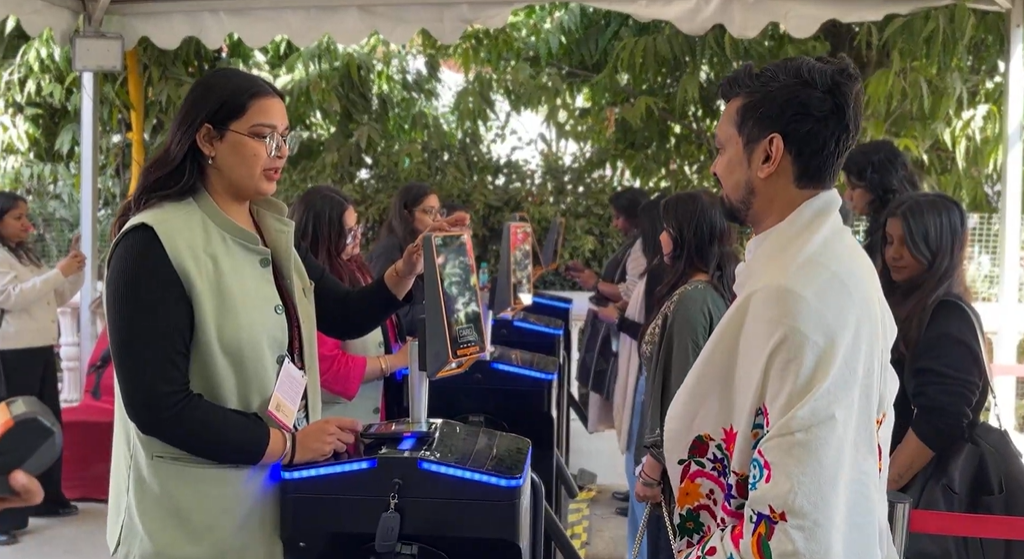
This isn’t theoretical design; it is proven operational reality.
During the Jaipur Literature Festival (JLF), the Dreamcast’s automated access ecosystem managed an aggregate footfall exceeding 300,000+ attendees across the multi-day event footprint at Hotel Clarks Amer.
By utilizing FR-based event check-in systems, on-site kiosks, and real-time dashboards, Dreamcast fundamentally transformed the venue’s entry logistics.
| Operational Metric | Manual Setup | Dreamcast Model |
| Active Counters | 16 Physical Search Desks | 4 Automated Lanes (75% reduction) |
| Check-In Speed | 30 to 40 seconds per person | 5 seconds per person |
| Peak Surge Flow | Hours-long entry lines | Continuous, Zero-Queue Flow |
| Data Sync | Delayed manual tallies | Instantaneous Dashboard Tracking |
You can read the comprehensive operational breakdown in the Dreamcast’s official Jaipur Literature Festival Case Study.
Or watch how the system handled the crowd flow in this On-Site Video Coverage.
The Key Takeaway: Speed beats size. Instead of setting up 16 manual counters, using 4 high-speed lanes of a FR-based event check-in system easily handled over 3 Lakh attendees while slashing hardware costs and gate waiting times.
How Accurate Is Facial Recognition for Event Check-ins?
The answer is:
Facial recognition event check-in systems can achieve up to 99% accuracy at large-scaleevents when supported by high-quality attendee photos, proper lighting, stable internet, and professionally configured AI systems.
This level of accuracy is one reason why facial recognition for events is increasingly used at conferences, expos, concerts, trade fairs, and corporate summits where thousands of attendees must be verified quickly and securely.
AI-powered event check-in systems identify attendees by analyzing unique facial points such as eye spacing, jawline structure, and facial proportions. The live face scan is then matched with the attendee’s registration image within seconds.
However, facial recognition accuracy may decrease if:
- Registration images are blurry: Low-quality photos make live face matching slower and less accurate.
- Venue lighting is poor: Extremely dark or overexposed environments can affect facial detection performance.
- Cameras are positioned incorrectly: Wrong camera angles may reduce successful face recognition during attendee movement.
- Attendees wear masks or sunglasses: Covered facial features can limit AI facial mapping accuracy.
- Network performance becomes unstable: Slow internet can affect the real-time facial recognition event check-in processing speed.
To maintain high facial recognition accuracy, professional event technology providers use high-resolution cameras, anti-spoofing technology, live AI matching, and real-time monitoring during event operations.
Is Face Recognition Better Than QR Code Check-in?
The short answer is yes, especially for high-volume mega-events. While QR codes are an excellent, cost-effective alternative for smaller formats, they introduce significant friction points when processing a massive crowd of 50,000 to 1 Lakh+ attendees.
To understand why enterprise organizers are upgrading their entry infrastructure, let’s compare the two technologies across critical operational parameters:
| Feature / Metric | QR Code Ticket Scanning | Enterprise Facial Recognition Check-in System |
| Average Processing Speed | 8 to 15 seconds per person | Under 5 to 10 seconds per person |
| Maximum Hourly Flow Rate | Approx. 300 attendees per lane | Approx 720+ attendees per lane |
| Device Dependency | High (Requires phones, printed paper) | Zero (Attendee is the ticket) |
| Security & Ticket Sharing | Vulnerable (Easy to screenshot/forward) | 100% Secure (Linked to biometric identity) |
| On-Site Staff Requirements | 1 to 2 handlers per scanning lane | Minimal exception- only supervisors |
The Operational Differences
1. Eliminating the “Device Fumble” Delay
A QR code scan seems fast, but the overall time allocation is dragged down by human variables. Attendees must stop, pull out their smartphones, unlock them, search for an email or event app, turn up the screen brightness, and aim it at a scanner. If a screen is cracked or too dim, the lane backs up.
Facial recognition turns the attendee into the ticket. As they walk up to the gate, high-speed camera kiosks scan and print a badge automatically. This drops the complete check-in loop to under 5-10 seconds.
2. Absolute Security and Fraud Prevention
QR codes can easily be screenshotted, shared, or passed back to unauthorized individuals outside the venue boundaries. This creates a severe revenue leak and a security risk for VIP access spaces. Because an FR-based event check-in system uses facial recognition topology, it completely stops ticket fraud and duplicate entries.
In Simple words, QR codes work fine for small workshops or minor breakout sessions. But for massive crowds of 1 Lakh+ people, facial recognition is much better. It slashes your equipment costs, cuts down on gate staff, and lets attendees walk straight in without waiting in long lines.
How Does Dreamcast Use Facial Recognition for Event Check-ins?
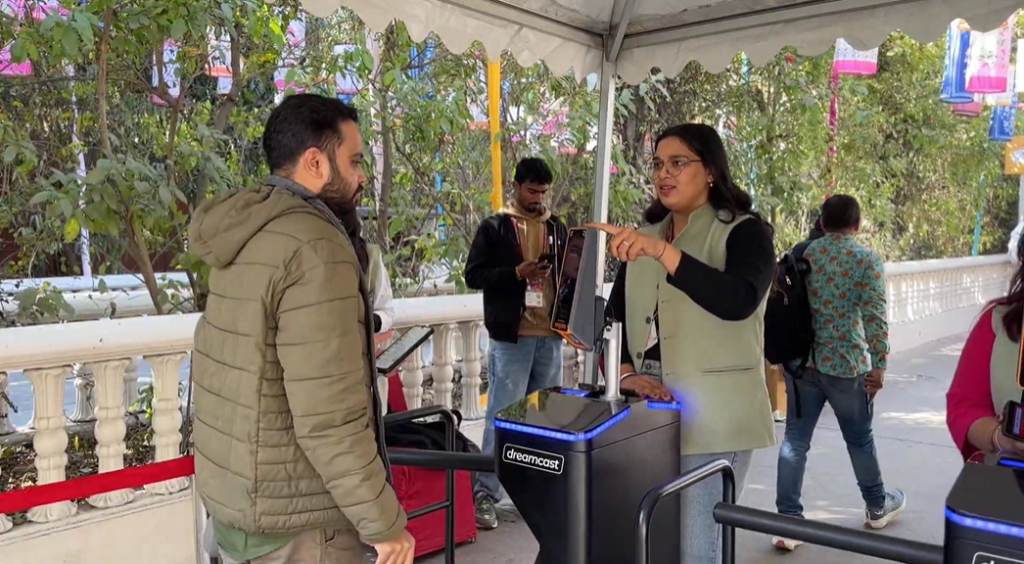
Dreamcast transforms event access control by shifting from manual verification to an AI-first, zero-queue deployment framework. The entire check-in architecture is optimized across three simple steps
How It Works: The 3-Step Dreamcast Facial Recognition Check-in Flow
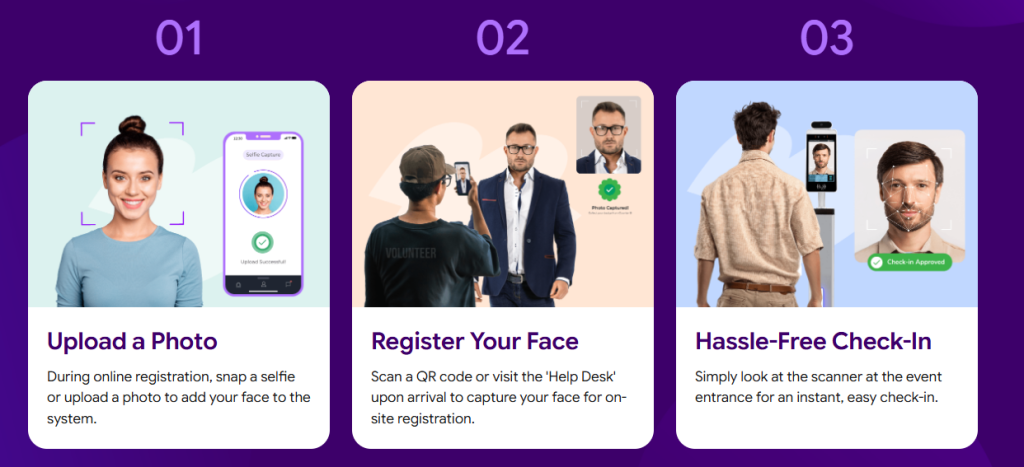
Source:- https://www.dreamcast.in/facial-recognition
Step 1: Upload a Photo
The easiest way to ensure a fast entry is to complete registration before arriving at the venue. During online event registration, attendees simply snap a quick selfie or upload an existing clean photo to add their face profile to the event database.
Step 2: Register Your Face (On-Site Alternative)
If an attendee skips the online photo upload or registers right at the venue doors as a walk-in, the system accommodates them instantly.
Upon arrival, the attendee can scan a targeted QR code on their phone or visit a physical, designated ‘Help Desk’ station. A staff member or volunteer uses a terminal camera to capture a quick profile photo on the spot.
Step 3: Hassle-Free Check-In
On the day of the event, entering the venue requires zero physical tickets, paperwork, or mobile screen fumbling.
The attendee walks up to the designated gate entrance and simply looks at the automated high-definition scanner terminal or camera kiosk. After the successful verification, the system will automatically open the turnstile gate and allow the attendee to enter.
What Types of Events Benefit Most From Facial Recognition Entry?
While any physical event can deploy biometric check-ins, certain formats see an immediate operational transformation. If your event footprint relies on moving large crowds quickly or keeping restricted boundaries secure, facial recognition provides a major logistical advantage.
The table below breaks down the specific event formats that benefit the most and their primary use cases:
| Event Type / Format | Core Operational Challenge | The FR Check-in Solution & Impact |
| Large-Scale Expos & Conventions (50k to 1 Lakh+ Guests) | Severe morning bottlenecks at badge-pickup desks due to concentrated crowd arrival. | High-Speed Ingress: Self-service kiosks process lookups and print active badges in under 10 seconds, clearing the peak rush smoothly. |
| Music Festivals & Stadium Sports (Massive Public Crowds) | Ticket sharing, screenshot fraud, and duplicate entry attempts at outer boundaries. | Fraud Elimination: Connects ticket validation directly to an individual’s encrypted facial token, completely stopping ticket passing and fraud. |
| VIP Galas & Corporate Summits (High-Touch, Elite Guest Lists) | Maintaining an exclusive, high-end welcome experience without tedious paper lists or slow check-ins. | Fast-Track Premium Lanes: Instantly recognizes VIPs on approach, flashes custom greetings, and alerts coordinators via a live dashboard. |
| Multi-Day Conferences (Restricted Track Sessions) | Deploying dozens of floor staff to manually check badges at individual room doorways. | Smooth Session Tracking: Compact terminals at room entryways automatically verify session access rights on the move while tracking real-time attendance data. |
What Should I Check Before Choosing a Facial Recognition Event Check-in Provider?
Selecting the right technology vendor can make or break your event’s entry logistics. To protect attendee data security, avoid on-site network crashes, and keep entry lanes completely fluid, organizers must carefully evaluate a provider’s infrastructure.
Looking for FR-based check-in system selection criteria? Wait and use this operational checklist table to evaluate your check-in system provider before signing the contract:
| Evaluation Category | Core Requirement Questions | What to Look For (The Gold Standard) |
| 1. Processing Speed & Concurrency | Can the system handle thousands of simultaneous scans across multiple gates without lag? | Sub-second matching: Look for systems that process biometric queries and trigger badge printing in under 5 to 10 seconds per person. |
| 2. Offline Capabilities | What happens if the venue’s primary internet connection completely drops? | Local Server Failover: The provider must offer on-site local server backup models that continue to match faces locally, even with zero active internet connection. |
| 3. Privacy & Data Security Compliance | How does the system handle, encrypt, and delete attendee facial data? | Tokenization & Compliance: The system should convert images into encrypted mathematical tokens instead of storing raw photos. Ensure they comply with local privacy regulations and delete data post-event. |
| 4. Environmental Adaptability | How does the hardware perform under harsh sunlight, evening darkness, or shadow angles? | Advanced Terminal Hardware: Look for kiosks equipped with dual-lens cameras, built-in LED lights for automatic exposure balance, and wide-angle biometric lenses. |
| 5. Multi-Channel Photo Collection | How easy is it for attendees to upload their pictures before arriving at the venue? | Online Registration Platform: Look for flexible platforms that let guests upload photos via custom registration web links. |
| 6. Fraud & Security Protection | Can the system be tricked by a high-resolution photo on a smartphone screen or a printed cutout mask? | Passive Liveness Detection: Ensure the AI uses anti-spoofing algorithms that analyze depth, micro-movements, and skin texture to confirm a real person is at the gate. |
Read More: – Questions to Ask Before Choosing an Event Check-In Solution
Final Words:-
Managing check-ins for thousands of attendees is no longer possible with slow, outdated entry methods alone. Large events now require faster, smarter, and more secure attendee verification systems that can handle heavy crowd movement without creating long queues at entry gates. This is why facial recognition event check-in is becoming an important part of modern event management. AI-powered facial recognition systems help organizers improve attendee flow, reduce manual verification delays, strengthen event access control, and support contactless event entry at conferences, expos, concerts, trade fairs, and corporate events.
In this article, we explained how facial recognition for events works, what technologies power AI-based attendee verification, how accurate these systems are, and how they can efficiently manage high-volume event check-ins across multiple entry lanes.
Ultimately, executing this level of logistical efficiency requires more than just smart software; it demands a smart, proven ecosystem. Enterprise-level event check-in solution providers like Dreamcast are bridging this gap, helping organizers conquer large-scale attendee entry with sub-second verification, superior crowd management analytics, and a flawlessly smooth event check-in experience. By removing human friction from the entry boundary, you don’t just secure your event footprint- you fundamentally elevate your brand’s first impression.
Don’t let manual check-in methods create hazardous bottlenecks at your outer gates. Book a Free Live Demo with Dreamcast Today and discover how our AI-powered facial recognition ecosystem can simplify your venue entry logistics, reduce on-site staffing overhead, and deliver a premium, zero-wait check-in experience for your attendees.
People Also Ask
Yes. Dreamcast provides an enterprise-grade, AI-powered facial recognition ecosystem designed specifically for secure, high-speed event check-ins, on-demand badge printing, and contactless entry control.
It works in a simple 3-step workflow:
– Upload: Attendees submit a selfie during online registration.
– Tokenize: The AI securely converts unique facial features into an encrypted token.
– Verify: On-site camera terminals scan the attendee’s face at the gate, match the token in milliseconds, and instantly allow entry.
Enterprise-grade facial recognition check-in system maintains an exceptional accuracy rate between 99.5% and 99% under standard event conditions, keeping the False Acceptance Rate (FAR) under 0.001% to virtually eliminate identity mismatches.
Yes. By deploying a high-concurrency cloud architecture, optimized biometric database indexing, and dedicated venue network balancing, systems can process over 1 Lakh attendees effortlessly without server lag or line delays.
Facial recognition is over 3x faster. While a QR code check-in takes 8 to 15 seconds due to device fumbling (unlocking phones, finding tickets, adjusting brightness), a facial scan takes under 5-10 seconds because the attendee’s face is the ticket.
Yes. Professional check-in terminals are designed with built-in, automated LED lights and high-definition wide-angle lenses that automatically compensate for dim evening lighting, heavy shadows, or indoor venue environments.
Yes. Dreamcast uses advanced biometric tokenization, which instantly converts facial landmarks into anonymous, encrypted mathematical strings instead of saving raw photos.
Absolutely. Because a ticket is permanently tied to an individual’s unique, encrypted biometric profile rather than a shareable barcode, it eliminates ticket passing, duplicate prints, and screenshot fraud.
If a face cannot be matched- due to extreme changes in appearance, poor registration photo quality, or deep shadows- the system instantly flags a minor exception, routing the guest to a designated Help Desk for a quick manual lookup or on-site photo registration.
Yes. Organizers can establish designated fast-track lanes for VIPs. When a VIP passes the scanner, the system unlocks the gate instantly and triggers a real-time notification on the organizer’s dashboard to alert coordination teams.
Biometric entry is primarily utilized by large-scale expos and conventions (50k+ crowds), major music festivals and stadium sports events, high-end VIP corporate summits, and multi-day conferences requiring secure track-session access control.