TL;DR
Government events are not open to everyone. The registration software must keep out strangers, get approvals from the right officers, and protect people’s data.
- Four registration models: open with controls, invite-only, approval-based, and quota-based RSVP. Many events mix them.
- Approval workflow: the applicant submits, automated checks run, then one or more officers review, and an approved applicant gets a QR e-pass. Every step is logged for audit.
- Identity checks: use OTP, ID upload, DigiLocker, or official email domains. Aadhaar can’t be demanded freely, so confirm your legal basis first and prefer offline or masked verification.
- Access zones: each category (VIP, media, staff, vendor) is tied to specific zones, gates, and time windows.
- Security and privacy: encryption, MFA, India-based hosting, audit logs, and a DPDP Act-aligned approach (minimal data, consent, deletion).
- Event day: fast QR check-in, offline mode, anti-fraud scans, live dashboards, and a clear escalation path.
- Choosing software: check the eight points: registration models, approval workflows, identity verification, access zoning, security, DPDP readiness, event-day performance, and support and procurement fit.
Introduction
A ministry summit, a state investor meet, a Digital India outreach programme, a Republic Day enclosure: none of these can be run with a public Google Form and a spreadsheet. The guest list is sensitive, the venue is often restricted, and one unauthorised entry can become a security incident or a news story.
That is why government event registration software in India is a distinct category. It has to handle controlled access, multi-level approvals, identity checks, data protection law, and heavy on-ground footfall, all at once. This guide explains how government event registration software in India works and how to choose it.
What makes government event registration different from regular event registration?
Corporate and public events optimise for reach: more sign-ups, more ticket sales, more buzz. Event registration for government events optimises for the opposite: the right people, verified, in the right place.
Key differences:
- Controlled attendance. Many events are invite-only or approval-only. Open registration is the exception, not the rule.
- Hierarchical sign-off. A registration may need review by a department officer, a protocol team and a security agency before it is confirmed.
- Security screening. Attendee lists are often shared with police or protection agencies in advance.
- Tiered access. Dignitaries, officials, media, delegates, vendors and staff each need different zones and entry gates.
- Compliance and audit. Every approval, rejection and data access needs to be traceable.
- Scale and accountability. Public-sector events can run from 50 guests to 50,000 attendees, and the organiser answers for every decision.
A tool built for webinars or ticketed concerts rarely covers these needs. Purpose-built government event registration software in India treats security, approval, and audit as core features rather than add-ons.
The security risk is not theoretical. Cyber incidents handled by CERT-In rose from about 13.9 lakh in 2022 to over 29 lakh in 2025, so a registration tool for official events has to be built as a security system.
What are the main registration models for government events?
Most government events fit one of four models, and good government event registration software in India supports all of them. Many large events combine two or more.
1. Open registration with controls
Suitable for public awareness campaigns, citizen outreach events, or career fairs. Anyone can register, but you add guardrails: capacity caps, duplicate detection, OTP verification, and a waitlist.
2. Invite-only event registration
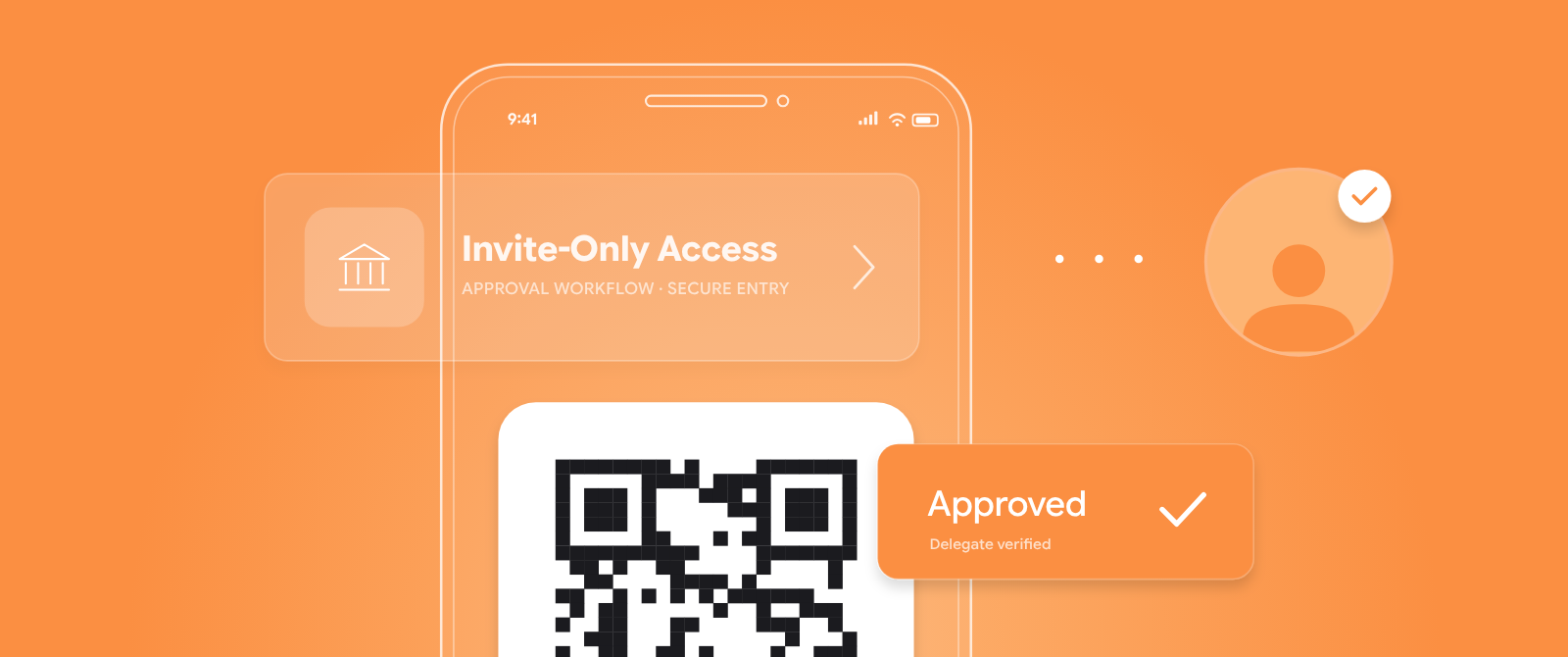
The most common model for protocol-sensitive events. Organisers upload a guest list, and each invitee receives a unique, non-transferable registration link or code. Only invited people can complete registration, and the link cannot be forwarded to someone else.
Good invite-only event registration software lets you:
- Import guest lists from Excel or CSV and map them to categories
- Send personalised invitations by email, SMS or WhatsApp
- Lock each link to one individual, with optional plus-one rules
- Track who has viewed, accepted, declined or ignored the invite
- Revoke or reissue an invitation instantly
3. Approval-based event registration
Here, people can apply to attend, but no one is confirmed until an authority approves. This suits conferences with limited seats, delegate programmes, media accreditation and vendor passes. Approval-based event registration gives organisers a clean screening layer without turning the event into a closed guest list.
4. Quota-based RSVP management
Seats or passes are allocated by category: for example, 200 for government officials, 100 for industry delegates, 50 for media, 30 for academia, and 20 reserved for the minister’s office. Quota-based RSVP management stops one group from consuming the whole capacity and lets each stakeholder department manage its own allotment.
A good system lets a nodal officer from each department invite or approve within their own quota, while the central team sees the full picture in real time.
How does an event approval workflow work?
An event approval workflow is the set of rules that decides who reviews a registration, in what order, and what happens next. In government settings, it replaces long email chains and WhatsApp forwards with a structured, auditable process.
A typical flow looks like this:
- Submission. The applicant fills in a registration form with name, designation, organisation, category and identity details.
- Automated checks. The system flags duplicates, incomplete forms, mismatched IDs and applicants already on a blocklist.
- First-level review. A department nodal officer or event coordinator checks eligibility and category.
- Second-level review. Protocol, security or senior officials approve, reject or ask for more information.
- Decision. The applicant gets an approved, waitlisted or rejected status, with a reason where appropriate.
- Pass issuance. On approval, a QR-coded e-pass is generated and delivered, mapped to the right access zones.
- Audit trail. Every action is logged with the user, timestamp, and comment.
Features worth looking for in the workflow engine of government event registration software in India:
- Configurable stages. One-, two-, or three-level approvals, depending on the event.
- Role-based reviewers. Each reviewer sees only the applications relevant to them.
- Bulk actions. Approve or reject hundreds of applications at once when the list is clean.
- Conditional routing. Send media applications to the communications team and foreign delegates to a protocol desk automatically.
- Escalations and reminders. Pending approvals do not stall just because one officer is travelling.
- Templates. Reuse the same workflow for recurring events such as annual summits.
The real value is accountability. If someone asks later why a person was admitted or denied, you have a documented answer.
How do you verify attendee identity at government events?
Identity verification is where many organisers using government event registration software in India get uncertain, particularly around Aadhaar. A few principles keep you on the right side of both security and law.
Common verification methods
- OTP verification on mobile number and email, to confirm the applicant controls the contact details they supplied.
- Government photo ID upload, such as a passport, voter ID, driving licence or official employee ID, reviewed by an approver.
- DigiLocker-based document fetch, where the person shares a verified document directly from the issuer.
- Official email domain checks, such as gov.in or nic.in addresses, to validate government employees.
- Pre-verified guest lists, where identity was established by the inviting office.
- On-site ID matching, where the badge is checked against a physical ID at the gate.
A note on Aadhaar-verified event registration
Aadhaar-verified event registration is a popular search term, but it needs careful handling. After the Supreme Court’s 2018 Puttaswamy judgment and the subsequent legal framework, Aadhaar authentication is not something every organiser can freely demand. Government bodies can use it where a law or notification supports it, while private entities face significant restrictions.
If your event is run by a government department, confirm with your legal or IT team whether Aadhaar-based authentication is permitted for your specific purpose. Where it is, prefer privacy-preserving approaches such as offline verification using Aadhaar QR or paperless offline e-KYC, and masked Aadhaar numbers. Never collect or store full Aadhaar numbers unless you have a clear legal basis and a strong reason.
For many events, alternatives such as DigiLocker, official email verification, and a photo ID check at the gate give sufficient assurance with far less risk. Treat this paragraph as general guidance and confirm requirements with your legal advisers, as rules and notifications change.
How do you manage VIP, media, and staff access zones?
Once registrations are approved, the next challenge is making sure people only go where they are meant to, which is why multi-zone access control and separate VIP entry points matter so much. Government venues usually have layered zones: a main hall, a VIP lounge, a green room, a media enclosure, a press conference area, a back-of-house operations space, and sometimes a restricted stage area.
Government event registration software in India helps by tying every attendee category to a zone access matrix:
| Category | Main hall | VIP lounge | Media enclosure | Backstage |
| Dignitary | Yes | Yes | No | Yes |
| Official delegate | Yes | No | No | No |
| Media | Yes (designated area) | No | Yes | No |
| Event staff | Yes | Limited | No | Yes |
| Vendor | No | No | No | Limited |
Best practices:
- Colour-coded and QR-coded badges so security staff can recognise access levels at a glance.
- Separate entry gates and lanes for VIPs, general attendees and media, so that protocol-sensitive arrivals never queue with the crowd.
- Time-bound passes, valid only for specific sessions or entry windows.
- Vehicle passes linked to the same approval record, which is useful for parking and convoy planning.
- Escort and accompanying-person rules, defined per category, with a cap on plus-ones.
- Live zone dashboards show how many people are in each area, helping with capacity and safety planning.
When the access matrix is integrated into the registration system, there is no mismatch between what is approved and what the gate scanner permits.
How should organizers handle data security and privacy?
Government event data is sensitive: names, designations, phone numbers, ID documents, travel details, and, sometimes, security clearances. Treat government event registration software in India as a security system, not a marketing tool.
The stakes are real. IBM’s 2025 Cost of a Data Breach report put the average organisational cost of a data breach in India at a record ₹220 million, about 13% higher than in 2024.
Security essentials
- Encryption in transit and at rest, with modern TLS and encrypted databases and backups.
- Role-based access control and multi-factor authentication for every admin and approver account.
- Hosting in India, ideally on MeitY-empanelled or equivalent government-approved cloud infrastructure, where your project requires it.
- Audit logs for logins, exports, approvals and edits, retained as required by your department.
- Regular testing, including vulnerability assessment and penetration testing by a CERT-In empanelled auditor where mandated.
- Incident response readiness. Under CERT-In directions, certain cyber incidents must be reported within six hours of detection, so your vendor needs a clear process.
- Download and export controls, so a guest list cannot be quietly copied to a personal device.
Privacy and the DPDP Act
India’s Digital Personal Data Protection Act, 2023 and its rules set out obligations around consent, purpose limitation, data minimisation, security safeguards, breach notification and deletion. Government agencies may have specific exemptions in certain situations, but you should not assume your event qualifies. Practical steps:
- Collect only what the event actually needs.
- Show a clear notice explaining why data is collected and who sees it.
- Obtain and record consent where it applies.
- Set retention limits and delete or anonymise data after the event.
- Be clear about who is the data fiduciary and who is the processor when you engage a vendor, and put it in the contract.
- Provide a channel for correction and grievance requests.
The DPDP Rules were notified in mid-November 2025, with the main compliance obligations taking effect from 13 May 2027.
Penalties can reach ₹250 crore for security failures, ₹200 crore for breach non-notification or violations involving children’s data, and ₹50 crore for other violations.
The DPDP rules are being implemented in phases, so check the current timelines, look at how DPDP applies to attendee data at event check-in, and take advice from your legal team.
Accessibility and standards
Public-facing government portals should follow the Guidelines for Indian Government Websites (GIGW) and WCAG accessibility standards. Registration pages should also work on low-bandwidth mobile connections and support Hindi and regional languages where the audience demands it.
What happens on event day? Check-in and on-ground support
Even the best pre-event workflow fails if the gate is chaotic, so government event registration software in India must support the gate as well. Event-day operations should be designed for speed, resilience, and discretion.
Fast check-in. QR scanning at the gate should take only a couple of seconds per person. Use dedicated lanes, and consider multiple scanning devices per lane for large crowds.
Offline mode. Venues like convention centres, stadiums and field locations often have weak connectivity. Your software should be able to sync the approved list to scanning devices ahead of time and keep working without internet, then upload check-in data later.
Anti-fraud checks. Dynamic or one-time QR codes, duplicate scan alerts, and photo-on-badge display prevent passes from being shared or screenshot-forwarded.
Walk-in and on-spot handling. Some events allow limited on-spot registration. Keep this behind a supervisor approval step so it does not become a loophole.
Badge printing. On-site kiosks or counters can print badges instantly, and pre-printed badges and self-check-in kiosks can cut queue time further, with a separate fast-track desk for VIPs and for people who need help.
Real-time dashboards. Control rooms should see arrivals, no-shows, zone occupancy and flagged scans live, with alerts when a restricted zone exceeds its limit.
Help desk and escalation. Trained staff, a clear escalation matrix and a direct line to the technical team are essential. Someone must have authority to resolve a disputed entry quickly and quietly.
Post-event reports. Attendance by category, department-wise turnout, entry-time distribution and incident logs feed directly into your after-action review and any official reporting.
How to choose government event registration software in India (8-point checklist)
Use this checklist when comparing vendors of government event registration software in India or preparing a tender.
- Registration models supported. Can it handle open, invite-only, approval-based, and quota-based registration in one platform, with the ability to mix them for a single event?
- Configurable approval workflows. Look for multi-level approvals, role-based reviewers, conditional routing, bulk actions, and complete audit trails.
- Identity verification options. Does it support OTP, document upload, DigiLocker and official email validation? Does the vendor clearly explain its Aadhaar approach, including what it stores and what it does not?
- Access control and zoning. Can you define categories, zones, time windows, vehicle passes and plus-one rules, and enforce them at the gate?
- Security posture. Ask about encryption, MFA, India-based hosting, security certifications such as ISO 27001, third-party audit reports, penetration testing and incident response commitments. Vendor compromise accounted for 17% of breaches in India, so this is the point where due diligence matters most.
- DPDP readiness and data governance. Check consent capture, retention controls, deletion tools, data processing agreements and breach notification procedures.
- Event-day performance. Test offline check-in, scan speed, dashboard accuracy, device compatibility and support during peak footfall. Ask for references from large events.
- Support, scalability and procurement fit. Is there on-ground and 24×7 support, multi-language and accessible interfaces, integration with existing government systems and email/SMS gateways, and a procurement route that works for your department, such as GeM availability?
A good test is to run a pilot with a real department list. Watch how the vendor handles messy data, last-minute changes, and a surprise VIP addition. That reveals more than any demo.
Final thoughts
The best government event registration software disappears into the background. Invitees receive the right pass, approvers see only what they need to, security gets a clean and verified list, and the gate runs smoothly. Behind that calm surface is a system built for controlled access, defensible decisions, and responsible data handling.
If you are planning your next official event, start with the checklist above, define your registration model and approval chain first, and only then evaluate tools. That order saves time, avoids security gaps, and makes the day itself far easier to run.
FAQs
It is a platform that lets government departments and agencies manage registrations for official events with controlled access, approval workflows, identity checks, access zoning, secure data handling, and on-site check-in, along with audit trails and reporting.
It is a model where only people on a pre-approved guest list can register or receive a pass. Each invitee gets a unique link or code that cannot be transferred, so uninvited people cannot sign up even if they find the event page.
Simple registration confirms attendance automatically. An event approval workflow holds each application for review by one or more designated officers who approve, reject, or waitlist it, and it records every decision for audit.
No. There is no general rule making Aadhaar verification mandatory for event registration. Whether you may use it depends on the legal basis available to your organisation, and many events use DigiLocker, official IDs, or email verification instead. Check with your legal team before collecting any Aadhaar data.
It is the practice of allocating a fixed number of seats or passes to each category or department, such as officials, media, or industry delegates. Each group manages its own allotment, which prevents any one group from taking all the capacity.