

Table of Contents
- What they are: Dreamcast is an end-to-end event operations solution provider for mid-sized to enterprise events, covering registration, on-site check-in (QR, RFID, NFC, facial recognition), cashless payments, badge printing, and analytics in a single native stack. Swoogo is a registration-first event management platform with strong custom workflow building and a built-in event website/microsite builder.
- Who it’s for: Dreamcast is designed for high-footfall events, corporate conferences, festivals, and exhibitions that require on-ground hardware, multi-zone access control, and a single vendor. Swoogo is ideal for agencies and marketing teams managing multiple small-to-mid-sized events that need registration flexibility and branded event websites.
- Key differentiators: Dreamcast offers native RFID, facial recognition, and self-service kiosk check-in, while Swoogo primarily supports QR-based check-in with advanced capabilities available through third-party integrations.
- Cashless payments: Dreamcast provides a dedicated RFID/NFC cashless payment ecosystem, whereas Swoogo supports registration payments through Stripe.
- AI capabilities: Dreamcast includes facial check-in, AI-powered networking, and crowd intelligence features, while Swoogo offers more limited AI functionality.
- Pricing: Swoogo starts at approximately $11,800 per year with a public flat-rate model, while Dreamcast pricing is customized based on event requirements and scale.
Bottom line:
Choose Swoogo if your only focus is on event registration and event marketing flexibility. Choose Dreamcast when you need an integrated tech stack combining event registrations with on-ground execution at scale.
Modern events depend on event tech platforms for registration, on-site execution, attendee engagement, and post-event analytics. With so many providers in the market, choosing the right one for your event is not always straightforward.
This blog brings to you a detailed Swoogo vs Dreamcast comparison across the areas that matter most to organizers: registration, check-in, payments, networking, and analytics. Dreamcast is known for its strength in integrating online registrations with swift on-ground execution, including FR, QR, and RFID-based check-in and on-site badge printing. Swoogo is known for its highly customizable registration and event website builder.
In the Dreamcast vs. Swoogo debate, both platforms bring genuine strengths to the table. This blog breaks down where each one excels, so you can match the right platform to your event’s specific needs.
Table of Contents
Quick Comparison: Dreamcast vs Swoogo at a Glance
Take a sneak peek at the Dreamcast vs Swoogo comparison here:
| Factor | Dreamcast | Swoogo |
| Best For | End-to-end event operations | Custom registration workflows |
| Core Target Audience | Mid-to-enterprise planners | Non-linear events, agency planners |
| On-Site Check-In Tools | Yes, badges, kiosks, and facial recognition | Via third-party integrations |
| Pricing Structure | Custom quote | Flat rate per user seat |
What Is Dreamcast and Who Is It Built For?
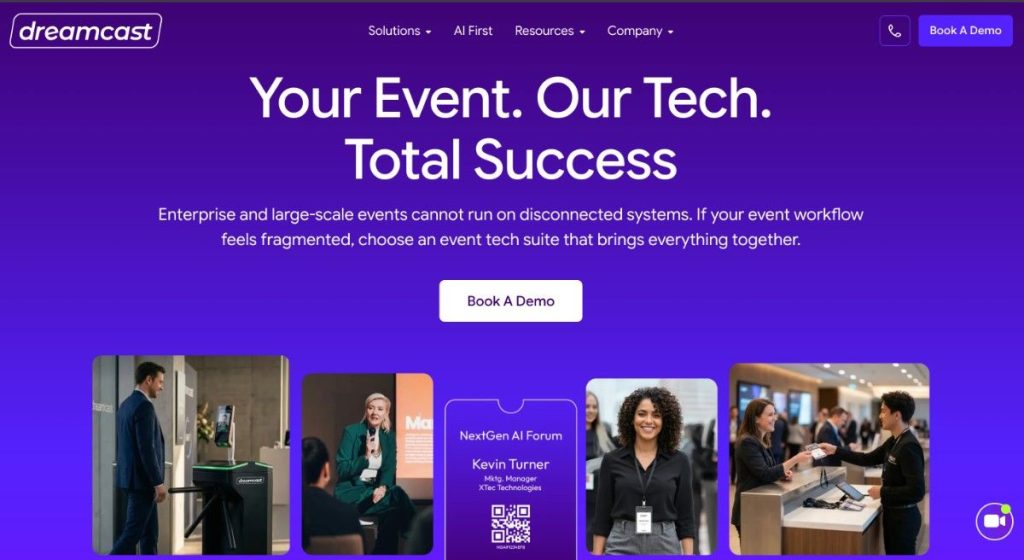
Dreamcast is a large-scale and enterprise-grade event technology provider with a complete tech stack to handle all major event processes. From large-scale event registrations to smooth on-ground operations using its in-house modular hardware, Dreamcast takes care of all major aspects of any event across in-person, virtual, and hybrid formats. Rather than stitching together multiple vendors, organizers run registration, check-in, badging, cashless payments, and analytics on a single connected platform.
Why Dreamcast Works For Mid to Enterprise Planners and Organizers
Large-scale events share a common set of requirements. Here are each of these requirements explained in detail, along with a clear view of how Dreamcast helps organizers tackle them:
1. Systems That Do Not Break Under High Footfall
Large-scale events bring a lot of people, fast. Everyone tries to register at the same time. Everyone checks in within the first hour. As per a Micepad article, State of Event Check-in: Statistics, Benchmarks & Trends, nearly 70% of attendees arrive during the first 90 minutes of an event, making peak-hour crowd management one of the biggest operational challenges for organizers. Payment systems get hit with thousands of transactions in a short burst. Many platforms are unable to handle this kind of pressure, and that is when things start to break.
The Dreamcast Edge: Dreamcast’s infrastructure is built and tested for high-volume environments. At the Jaipur Literature Festival 2026, the platform managed check-in and badge printing for 300,000+ attendees across five days without bottlenecks. For an enterprise planner, that is no less than a track record worth knowing about.
2. Tech That Syncs With On-Ground Conditions
Most platforms treat sign-up and check-in as two different processes that need to be connected later. This creates extra work. Attendees end up giving the same information twice. For example, staff have to match names on a list to hand out printed badges manually. It is slow, and it is where most mistakes happen.
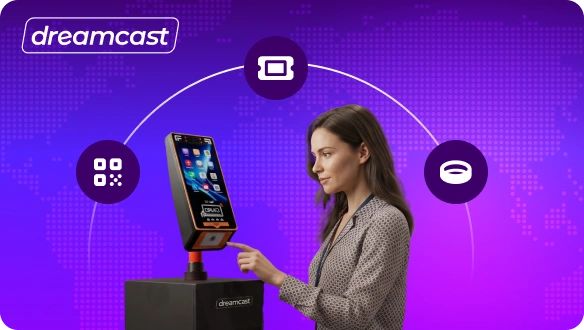
The Dreamcast Edge: Dreamcast connects sign-up and check-in into one continuous process. Whatever an attendee enters during registration is already there when they arrive. Nothing needs to be repeated. This includes badges, too. Instead of staff searching for the right printed badge, attendees pull up their own details at a kiosk and print their badge themselves.
Dreamcast’s self-service badge kiosk completes the entire badge process in just 10 seconds. Watch the Fastest Indian in action.
3. Strong Live Event Support
Many things can go wrong during events. A printer jams, a kiosk freezes, and the internet drops for ten minutes. When that happens during a product launch or a conference with thousands of people waiting to check in, panic sets in pretty quickly. Many platforms offer support over email or chat, which is too slow when the problem is happening live on the ground.
The Dreamcast Edge: Dreamcast provides on-ground technical teams during the event itself, not just pre-event setup support. For enterprise events where a malfunction during peak hours has real financial and reputational consequences, having a team physically present matters.
Here is what G2 reviewers say about Dreamcast’s on-ground support:
| What G2 Reviewers Say About Dreamcast | Dreamcast |
| Quality of Support | 9.8 |
| Ease of Use | 9.6 |
| Ease of Setup | 9.5 |
| Ease of Admin | 9.4 |
| Overall G2 Rating | 4.8 / 5 |
4. Scope for Structured Customization
Every event is a little different. Some have VIP sections. Some run for multiple days with different passes for different days. Need different access levels for staff, vendors, and guests. An event tech provider that only offers one fixed setup forces organizers to work around its limits instead of around their event.
The Dreamcast Edge: Registration forms, badge designs, access tiers, and accreditation workflows can all be configured to match an event’s specific structure, multi-day passes, role-based access, and VIP tiers without needing custom development for each event.
See how Dreamcast configures ticketing, registration, and branded microsites.

5. No Complicated Vendor Management
Running one event often means juggling several different tools. Forrester reports that 22% of large enterprises deploy six or more event technology solutions. It not only exerts massive pressure on event budgets but is also a herculean management task. One software for registration, another for check-in, another for payments, another for reporting. Each one needs its own setup, its own login, and its own support line. When something does not work, organizers spend time figuring out which vendor is responsible before they can even fix it.
The Dreamcast Edge: Because registration, check-in, payments, and analytics run from one place, organizers are not coordinating between four or five different vendors to get one event running. One point of contact, one system, one data source.
Summary: Dreamcast brings registration, check-in, badging, payments, and analytics together in one place, built to handle the scale, pressure, and unpredictability of mid to large events. For organizers managing high footfall, multiple access tiers, or complex on-ground logistics, this means easier tech management, faster execution, and on-ground support that shows up when it matters the most.
What Is Swoogo and Who Is It Built For?
Swoogo is an event management platform known for its flexibility in building custom registration workflows. It is particularly suited to organizers who run a high volume of varied event types, conferences, webinars, and internal meetings, and need a platform that can be configured differently for each one without starting from scratch.
Why It Works for Non-Linear Events and Agency Planners
Organizers running many different event formats have a different set of priorities. Here is how Swoogo addresses them.
1. Flexible Registration Workflows
Swoogo allows organizers to build distinct registration flows for different event types within the same platform. An agency managing ten different client events with ten different registration requirements can configure each one independently.
2. Event Website and Microsite Builder
Swoogo includes a built-in website builder, allowing organizers to create branded event microsites without separate web development resources. This is particularly useful for agencies managing multiple branded events simultaneously.
3. Integration-Led Architecture
Rather than building every capability natively, Swoogo connects with a range of third-party tools for functions like on-site check-in, payments, and virtual event hosting. This gives organizers flexibility to choose best-in-class tools for each function, provided they are comfortable managing multiple integrations.
4. Suited to Marketing and Agency Teams
Swoogo’s interface and workflow are often favoured by marketing teams and agencies who need to move quickly across many smaller events rather than operating one large, complex event.
Dreamcast vs Swoogo: Feature-by-Feature Comparison
1. Registrations:
| Swoogo | Dreamcast |
| Strong registration platform with highly customizable registration flows, payment collection, and conditional logic. Widely regarded as one of Swoogo’s core strengths. | Full registration suite with multi-tier registrations, secure payments, RSVP management, custom forms, attendee verification, and registration-to-onsite workflows. Registration is part of a broader end-to-end event stack. Aadhaar-based registration verification is available for events in India. |
2. Check-Ins
| Swoogo | Dreamcast |
| QR-based attendee and session check-in. Offline check-in supported. Walk-in registrations and kiosk mode are available. Primarily focused on standard conference/event check-ins. | QR, RFID, NFC, facial recognition, handheld scanners, self-service kiosks, volunteer desks, and turnstile integrations. Designed for high-volume entry management and access control. |
3. Cashless:
| Swoogo | Dreamcast |
| Limited. Swoogo supports payment collection during registration and can process onsite balances via Stripe, but it does not have a dedicated cashless event ecosystem. | Dedicated cashless event capabilities with RFID/NFC-based transactions. Clear focus on creating a fully cashless attendee journey. Particularly relevant for festivals, exhibitions, and large-scale events. |
4. In-House Badge Printing:
| Swoogo | Dreamcast |
| Offers on-demand badge printing through its onsite solution, with badge design, QR- based check-in, and printing workflows integrated into the registration experience. Badge issuance is primarily staff-assisted and dependent on separate hardware components. | FR + QR-based attendee retrieval, self-service badge printing, unified hardware ecosystem, and infrastructure built for high-volume attendee processing. |
5. Mobile Event App:
| Swoogo | Dreamcast |
| Branded attendee app with personalized agendas, communications, and configurable event experiences. | Fully customizable event app with branded experiences, networking, engagement, AI-powered features, and integration with registration, check-in, and onsite operations. Dreamcast’s mobile event app saw a 50% download rate at IMC 2025 in an attendee footfall of 150k. |
6. AI-First Features
| Swoogo | Dreamcast |
| Limited AI features | A full stack of AI features. Features include facial verification check-ins, AI networking recommendations, attendee assistance/chat, photo discovery, automated content clipping, AI-powered reporting, crowd intelligence, and AI-enhanced event apps. |
Summary: Across all six categories, Swoogo and Dreamcast take different approaches to the same underlying problem. Swoogo is strong where the focus is just on registration or website building. It offers flexible forms and regular payment collection methods with check-in and badging handled through QR codes and supporting hardware. Dreamcast’s registration capabilities are equally customizable and extend further into on-ground execution. Dreamcast provides RFID and facial recognition for check-in, a dedicated cashless ecosystem, self-service badge printing, and AI features woven across the attendee journey from registration to on-site engagement. The clearest gap is in categories tied to physical, high-volume events: cashless payments and AI-first capabilities, where Dreamcast offers dedicated infrastructure and Swoogo’s offering is comparatively limited or relies on third-party tools.
Dreamcast vs Swoogo: Pricing Comparison
| Pricing Factor | Swoogo | Dreamcast |
| Pricing Model | Annual subscription pricing available publicly. Starts at $11,800/year for 1 full user. | Custom enterprise pricing based on event requirements, scale, and solutions selected. Public pricing is not disclosed. |
| Events Included | Unlimited events. | Custom pricing based on event scope and deployment requirements. |
| Registrations Included | Unlimited registrations. | Custom quote based on event requirements. |
| Mobile Event App | Available as a paid add-on (Go Attend). | Included as part of Dreamcast’s broader event-tech ecosystem, depending on scope. |
| Onsite Solutions | Check-in included; advanced onsite capabilities available through add-ons. | Registration, check-in, badge printing, facial recognition, access control, and on-site support are available under a unified solution. |
| Support Model | Standard support included; premium support available as an upgrade. | Dedicated enterprise support and deployment-led implementation. |
| Best Fit | Organizations seeking a registration-first platform with predictable SaaS pricing. | Organizations seeking an end-to-end event-tech stack with custom implementation and on-site execution support. |
Summary: Swoogo offers predictable software pricing. Dreamcast offers a customized event-tech ecosystem that bundles software, onsite operations, hardware, support, and enterprise-grade event execution into a single solution.
Which One Should You Choose?
In the Dreamcast vs Swoogo decision, the choice largely comes down to where your event’s complexity sits, in the registration and marketing experience, or in the on-ground execution.
If your event is primarily about getting registration and event marketing right, and your team values a flexible, design-led platform that adapts easily across many different event formats, Swoogo’s strengths align well with that need.
If you are looking for a platform for corporate events that involves high footfall, custom registrations combined with on-site delivery, cashless payments, badge printing at scale, multi-zone access control, or AI-driven attendee experiences, and you would rather run all of this from one connected platform than coordinate between several vendors, Dreamcast’s end-to-end approach is built for that scenario.
For organizers who run a mix of both, smaller marketing-led events alongside large flagship events, it is worth evaluating which type of event represents the greater operational risk if something goes wrong. That is usually the deciding factor.
Conclusion
Dreamcast and Swoogo are not solving the same problem in the same way. Swoogo has built a strong reputation around registration flexibility and event websites. Dreamcast has built its platform around the operational realities of large events, where check-in speed, cashless payments, badge printing, and on-ground support directly affect whether the event runs smoothly.
Neither platform is universally better. The right choice depends on where your event’s complexity actually lives. If you are planning a high-footfall event and want to understand what an end-to-end setup looks like for your specific requirements, the Dreamcast team is happy to walk you through it.