


Table of Contents
Not every event should allow instant registration. Approval-based registration gives organizers control over who attends an event, while non-approval registration allows anyone who meets the registration requirements to receive instant confirmation.
The right choice depends on your event goals, audience, security requirements, and the attendee experience you want to deliver.
Key Takeaways
- Approval-based registration requires organizers to review and approve registrations before confirming attendance.
- Non-approval registration confirms attendees immediately after registration.
- Approval workflows are ideal for VIP events, B2B meetings, government events, investor summits, and invite-only conferences.
- Instant registration works best for public conferences, exhibitions, webinars, workshops, festivals, and community events.
- A smooth approval process can improve attendee quality while reducing fake or duplicate registrations. Industry benchmarks highlight the necessity of this filtering, as roughly 25% of open online ticket acquisitions involve counterfeit or invalid entries, introducing massive liability risks to unmonitored event perimeters.
- Most event organizers use online registration systems, while automated workflows can reduce administrative work by 30% to 50%.
- Choosing the wrong registration model can affect attendance, event security, and overall attendee satisfaction.
Introduction
A successful event starts long before attendees arrive at the venue. It begins with registration.
Many organizers spend weeks planning speakers, venues, sponsors, and marketing. Then they use the wrong registration process. The result is simple. Either too many unwanted registrations or too many genuine attendees waiting for approval.
That is why choosing between approval-based and non-approval event registration matters.
Both methods solve different problems. One focuses on control. The other focuses on speed.
For example, if you are hosting an investor meeting with 300 executives, approving every attendee makes sense. If you are organizing a public technology conference with 8,000 attendees, asking every person to wait for approval may only slow things down.
This guide explains how both registration methods work, where each one fits best, their advantages, limitations, and how to decide which option is right for your next event.
Table of Contents
What is Approval-Based Event Registration?
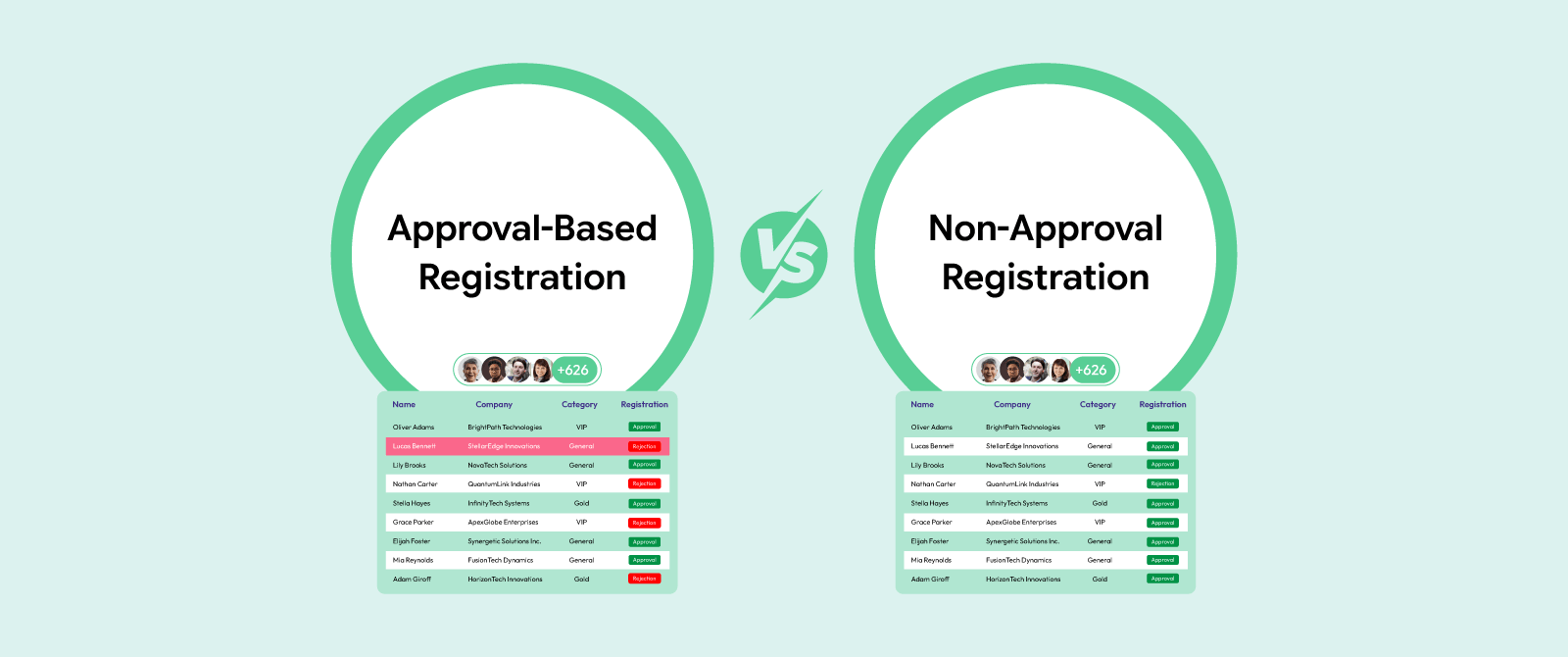
Approval-based event registration is a registration process where attendees submit their details first. The organizer reviews the application before confirming the registration. Instead of receiving an instant ticket, attendees wait until the organizer approves their request.

While this vetting ensures high data quality, organizers must balance form length carefully, as a report confirms that the average web form abandonment rate sits at roughly 68% when users encounter information fatigue.
The review process may include checking:
- Company details
- Job title
- Industry
- Invitation status
- Membership
- Payment verification
- Supporting documents
- Event eligibility
Once approved, attendees automatically receive confirmation emails, QR codes, digital badges, or event tickets. This method gives organizers complete control over attendance.
What is Non-Approval Event Registration?
Non-approval event registration is much simpler.
An attendee completes the registration form, makes payment if required, and immediately receives confirmation.
There is no manual review.
Everything happens automatically.
This registration style focuses on making the process fast and easy.
Baymard Institute indicates that optimizing the checkout flow to be seamless can increase overall digital conversion rates by up to 35%.
For large public events, every extra step can reduce registrations. Shorter registration forms improve completion rates, while complicated forms increase abandonment. That is why public events often choose instant registration.
Read More:- Best Event Registration Platforms for Effortless Event Management
How Do Both Registration Types Work?
Although both begin with an online registration form, the attendee experience becomes different after submission.
Approval-Based Registration Process
- The attendee submits the registration form.
- The system marks the registration as pending.
- Organizers review submitted information.
- Approved attendees receive confirmation.
- Rejected attendees receive a notification if configured.
- Approved attendees receive event passes, QR codes, or badges.
Non-Approval Registration Process
- The attendee fills the registration form.
- Payment is completed if applicable.
- Registration is automatically confirmed.
- The confirmation email is sent instantly.
- A digital ticket or QR code is generated immediately.
The second process removes manual work, making it suitable for events expecting thousands of registrations within a short period.
Which Events Need Approval Based Registration?
Not every event should be open to everyone. Some events require careful attendee selection because every participant affects discussions, networking quality, or security.
Approval-based registration works well for:
- Executive Conferences
Senior leadership events often accept only directors, founders, and decision-makers.
- Investor Meetings
Startups, investors, and venture capital firms usually verify attendees before granting access.
- Government Events
Government conferences often verify identity, organization, and security requirements before approval.
- Healthcare Conferences
Medical conferences sometimes require professional licenses or hospital affiliations before attendance.
- Media Events
Press briefings often approve journalists based on their media organizations.
- University Research Events
Academic conferences may verify researchers, faculty members, or invited speakers.
- Partner Meetings
Companies hosting partner summits may approve only certified partners or distributors.
Which Events Work Better With Non-Approval Registration?
Public events benefit from speed.

The easier registration becomes, the more registrations organizers usually receive.
Instant registration is commonly used for:
- Public conferences
- Trade shows
- Exhibitions
- Festivals
- Workshops
- Community events
- Webinars
- Product launches
- Networking events
- Educational seminars
For these events, reducing wait times improves the attendee experience.
What Are the Biggest Differences Between Approval and Non-Approval Registration?
Here is the difference between approval-based and non-approval event registration:
| Feature | Approval-Based Registration | Non-Approval Registration |
| Registration confirmation | After organizer approval | Immediate |
| Organizer review | Required | Not required |
| Registration speed | Slower | Faster |
| Security | Higher | Standard |
| Suitable audience | Selected attendees | Open audience |
| Manual work | Higher | Lower |
| Scalability | Moderate | Excellent |
| Best for | Private and exclusive events | Public events |
Why Do Some Organizers Prefer Approval-Based Registration?
Approval-based registration offers several practical benefits.
Reason 1: Better Attendee Quality
Organizers can ensure the right audience attends. Instead of attracting random registrations, they can build an audience that matches event goals. This is especially useful for networking events where attendee quality matters more than attendee quantity.
Reason 2: Better Security
Security has become an important concern for many events. Verifying attendees before approval reduces the chances of fake registrations, duplicate accounts, and unauthorized access.
Reason 3: More Valuable Networking
Business networking becomes stronger when attendees belong to similar industries or job roles. Approving registrations helps organizers create more meaningful interactions.
Reason 4: Better Capacity Management
Some events have limited seating. Approval allows organizers to balance attendee categories while avoiding overbooking. Managing these caps tightly avoids wasted resources, as multi-market data published by Event Tech Live shows that unvetted, free public business events routinely face a 40% to 60% no-show rate, leaving valuable venue capacity empty.
Why Do Many Organizers Choose Non-Approval Registration?
For public events, speed often matters more than manual control.
Reason 1: Faster Registration Experience
Attendees receive confirmation within seconds.
There is no waiting period.
This improves user satisfaction.
Reason 2: Lower Administrative Work
Manual approval takes time.
For events with thousands of registrations, reviewing every application becomes expensive. Automation reduces repetitive work and allows event teams to focus on attendee engagement.
Reason 3: Higher Registration Numbers
A long approval process can discourage registrations. Instant confirmation helps maintain momentum after marketing campaigns, email promotions, or social media advertisements.
Reason 4: Better for Large Events
Suppose reviewing 25,000 registration requests manually. That alone could take several days. Automatic registration removes that workload completely.
Can You Combine Both Registration Methods?
Yes. Many organizers now use hybrid registration workflows.
For example:
- VIP guests require approval.
- Speakers require approval.
- Sponsors require approval.
- Exhibitors require approval.
- General attendees receive instant confirmation.
- Students register instantly after payment.
- Media registrations go through manual verification.
This approach balances speed with control.
Advanced event registration platforms such as Dreamcast allow organizers to create different workflows for different attendee categories without creating separate registration systems.
Read More: Smart Strategies to Reduce High Event Registration Congestion
What Should You Consider Before Choosing One?
Before deciding, ask these questions.
Who Is Your Audience?
- If anyone can attend, instant registration usually works better.
- If attendance is limited to specific people, approval becomes useful.
How Important Is Security?
Higher security usually requires attendee verification.
How Large Is the Event?
- Events expecting several thousand registrations benefit from automation.
- Smaller invite-only events often benefit from manual review.
Is Networking the Main Goal?
If attendee quality directly affects networking, approval helps maintain that quality.
How Much Time Does Your Team Have?
- Manual approvals require dedicated staff.
- If your team is small, automatic registration may be a better option.
Final Thoughts
Both approval-based and non-approval registration are effective. The better choice depends on your event rather than the software itself.
If your event depends on selecting the right audience, protecting access, or creating exclusive networking opportunities, approval-based registration gives you greater control.
If your goal is to attract as many attendees as possible while keeping registration simple and fast, non-approval registration is usually the better option.
Many organizers now combine both methods to match different attendee categories. This gives them flexibility without making registration difficult. The best registration process is the one that supports your event goals, creates a smooth attendee experience, and reduces unnecessary work for your event team.
FAQs (Frequently Asked Questions)
Approval-based event registration requires organizers to review and approve attendee registrations before sending confirmation and event access.
Non-approval event registration automatically confirms attendees immediately after they complete the registration process and payment, if required.
It depends on the conference. Public conferences usually benefit from instant registration, while executive, government, healthcare, and invite-only conferences often require approval-based registration.
Yes. It helps organizers verify attendee information, reduce fake registrations, and control who can access the event.
Yes. Many events approve VIPs, speakers, exhibitors, and media while allowing general attendees to register instantly.
It can. That is why many organizers automate approval notifications and only review attendee categories that require verification.
Non-approval registration is generally better because it allows faster registrations, reduces manual work, and scales efficiently for thousands of attendees.