



Anyone who is familiar with the workings of the internet may be familiar with the word bitrate. Or anybody who spends time watching videos on the internet would have occasionally heard the term. However, it may be difficult to determine what something exactly means in today’s society with all of the jargon and technical phrases. You’ve come to the appropriate place if you’ve been searching for the ideal explanation of the word “video bitrate.” This article discusses bitrate, how it impacts the quality of videos and the ideal video bitrate for streaming.
Table of Contents
What Exactly Is “Video Bitrate”?
Bitrate is a crucial factor to take into account while transmitting content over the internet, notably audio and video information in general. It is also a top issue for live streamers and frequent users of streaming services. When discussing bitrate in online video transmission, the term is condensed to “video bitrate.”

In simple terms, Bitrate is the quantity of video data delivered in a specific period of time. It plays an essential role in adaptive streaming. Bits per second (Bps) is the unit of measurement. Bitrate is often expressed in megabits per second (Mbps) for streaming video and in kilobits per second (kbps) for audio. Simple math says that 1000 kbps is equal to 1 Mbps.
In technical term, video bitrate refers to the amount of information sent per second from your device or server to the internet.
Resolution and bitrate are not the same. The amount of pixels that make up an image on your screen is referred to as resolution. Your image is more clearly defined the greater the resolution. The speed at which your file is processed is determined by bitrate, whilst the sharpness of your image is determined by resolution. The next time you hear the phrase “bitrate for 1080p,” you’ll know that it refers to an image’s resolution and pixel count.
Factors That Affect Video Bitrate
Various factors that determine the video bitrate are:
Resolution: The higher the resolution of the video, the more bitrate is needed to keep the quality up.
Frame Rate: Higher frame rate (60fps) needs moreBit rate.
Data Compression: New codecs such as H.265 (HEVC) lower bitrate requirements at the same quality.
Internet speed: The fastest bitrate a viewer can stream without buffering, which is determined by the viewer’s internet connection speed.
Streaming Platform: Various platforms recommended bitrates based on the audience and the infrastructure they had.
Video Bitrate Measurements
Video bitrate refers to the volume of video data transmitted at a given moment. One of the most important aspects of a video’s quality is its video bitrate. High video bitrates, high video resolutions, and high frame rates all contribute to appealing videos.
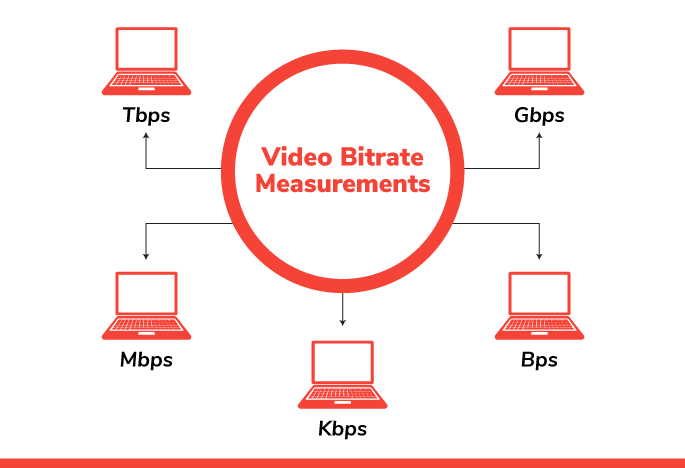
Typically, video bitrate streaming is expressed in kbps, which is equivalent to kb (kilobits) of data per second. So, a video at 1500 kbps will use up to 675 MB of data every hour, or 1500 * 60 * 60 kbps, or 8000 MBs of data. Similar to this, a 1-hour video at 1000 kbps will be 450 MB in size and one at 600 kbps would be 270 MB.
Bitrate can be measured in
- Tbps (Terabit per second)
- Gbps (Gigabit per second)
- Mbps (Megabits per second)
- Kbps (Kilobite per second)
- Bps (Bits per second)
Note:- Mbps and MBps are not similar. Mbps stands for Megabits per second). On the other hand, MBps stands for megabytes per second. So avoid mixing these two terms.
Tools and Techniques for Managing Bitrate
Bitrate management is key to optimizing video quality while keeping bandwidth consumption in check. Some important tools and techniques for managing these risks include:
- Encoding Software: HandBrake, Adobe Media Encoder, FFmpeg, etc with precise control over resulting bitrate
- Adaptive Bitrate Streaming (ABR): Protocols like HLS and MPEG-DASH deliver video at the optimal bitrate according to the internet speed of the viewer.
- Cloud Streaming Solutions: AWS Elemental Media Solutions, Wowza Streaming Cloud, etc., allow you the ability to optimally adjust the bitrate based on network conditions.
AI-Powered Bitrate Optimization: New AI-driven tools investigate the conditions of networks and adapt bitrates accordingly in the moment.
Types Of Bitrate
Variable bitrate
When a file is encoded, data is compressed according to its complexity using a variable bitrate. The average bitrate of your complete video or audio file is used to calculate this sort of bitrate; less complicated portions of your clip will have a lower bitrate than sophisticated ones. Video bitrate streaming typically results in a greater bitrate than continuous bitrate, making it more suitable for video-on-demand services than live streaming.
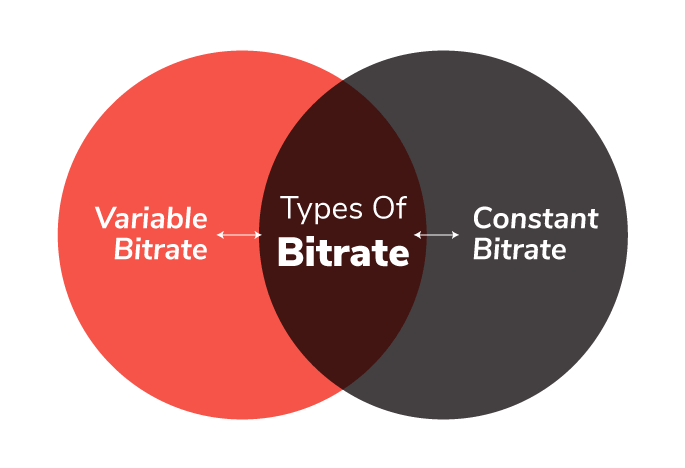
Constant bitrate
This type of bitrate is the most commonly used because of its usefulness for live streaming. Setting a constant bitrate transmission rate makes it easier for content to stream quickly on many different devices. If you create content to stream online, CBR will be the best choice when encoding your audio or video files. This type of bitrate output is considered the industry standard for online streaming. Plus, it is compatible with many different media players and streaming platforms.
How Does Bitrate Affect The Quality Of The Video?
The bitrate for streaming affects the quality of a video. A high bitrate allows for rapid data delivery, which provides the end user with a stream of professional quality. Since less data is being delivered per second at a lower bitrate, the stream quality will also suffer. In order to upload the video to the internet and view the stream without interruption, bitrate also aids in choosing the necessary bandwidth. Does this imply that we should transmit live video at the maximum bitrate possible? Well, no.
A greater bitrate for streaming equates to better video quality from a streaming perspective. However, a high bitrate makes the video larger and requires a lot of bandwidth from the viewers in order to process the data.
Consider a scenario where the video is broadcast at 12 Mbps and the end user’s download speed is 10 Mbps. In that instance, the broadcast will be delayed and choppy as a result of the internet connection’s inability to keep up with the volume of data being transferred.
A high-quality viewing experience for your audience may be provided by selecting the best bitrate for Youtube, Facebook, and other social media platforms. It takes some balance to get the ideal bitrate. It should be high enough for your video to be crisp and clear, but not so high that visitors have trouble seeing it.
Other Factors That Affect Video Quality
Frame rate: The frame rate gauges how quickly several images emerge inside a second. For instance, a video with 30FPS indicates that 30 pictures are shown in the video per second. Similar to resolution, the frame rate is a key component of video quality.
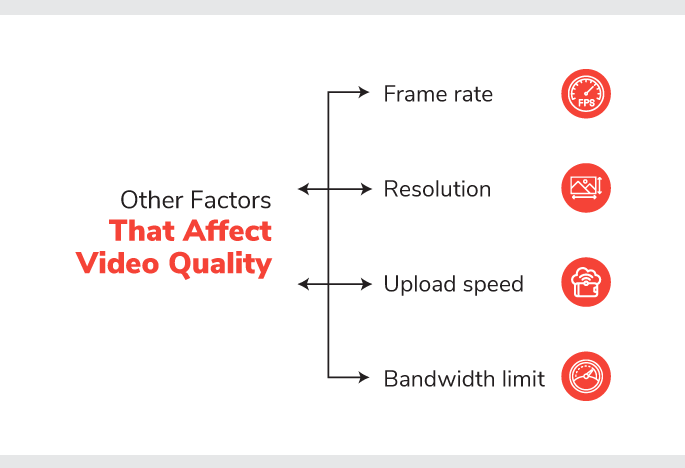
Resolution: Resolution is the number of pixels displayed per inch of a picture on our computer screens and describes the clarity and sharpness of the video. The image quality will be better the higher the resolution.
Connect with the Industry's Most Experienced
Live Streaming Service Providers.

FAQs About Video Bitrate
The ideal bitrate for 1080p video streaming is between 4,000-6,000 Kbps, depending on the frame rate and platform.
Yes, but only up to a certain point. Beyond a recommended bitrate, increasing it further will not significantly enhance quality.
This could be due to slow upload speeds, hardware limitations, or excessive bitrate settings exceeding viewers’ internet capabilities.
CBR (Constant Bitrate) keeps the bitrate steady throughout the video, while VBR (Variable Bitrate) adjusts it dynamically based on complexity.
You can use tools like OBS Studio, VLC Media Player, or online bitrate calculators to measure and optimize your video’s bitrate.