


Table of Contents
The most effective way to manage entry, exit, and re-entry at a large Garba event is by combining RFID-based access control, tripod turnstiles, dedicated entry and exit gates, real-time attendee tracking, and clear re-entry policies to maintain smooth crowd flow and prevent unauthorized access.
Managing attendee movement at a 30,000-person Garba event requires more than security personnel at the gates. A well-planned end-to-end access control solution using RFID-based card scanning, tripod turnstiles for entry/exit, and a structured re-entry management process helps reduce queues, improve attendee safety, and prevent unauthorized access throughout the event.
Table of Contents
Introduction
Garba events have grown significantly over the years, attracting tens of thousands of attendees every evening. While the performances, music, and celebrations are the main attraction, managing the movement of thousands of people safely is one of the biggest responsibilities for event organizers.
Unlike many events where attendees enter once and leave after the program, Garba events involve continuous movement. People arrive at different times, leave for food stalls or parking areas, meet friends outside the venue, and often return later. At the same time, organizers also need to manage performers, VIP guests, volunteers, vendors, sponsors, and media personnel, each with different access permissions.
Without a proper access management plan, long queues, overcrowded gates, duplicate entries, and security issues can quickly affect the attendee experience.
This is where an end-to-end access control solution becomes essential. By combining RFID-based card scanning, tripod turnstiles for entry/exit, and real-time monitoring, organizers can manage attendee movement efficiently while maintaining security from the first entry until the final exit. In this article, you will learn how to manage entry, exit, and re-entry effectively.
Why Access Control is Critical for Large Garba Events
Managing access for thousands of attendees is much more complex than simply checking tickets at the gate. Organizers must balance crowd movement, safety, and operational efficiency throughout the event.
Some of the most common challenges include:
- Thousands of attendees arriving within a short period before the event begins
- Multiple entry and exit points across a large venue
- Different access levels for attendees, VIPs, performers, staff, and vendors
- Guests leaving and returning during the event
- Preventing fake passes and duplicate entries
- Maintaining accurate venue occupancy for safety compliance
Traditional manual verification methods often struggle to handle these situations, leading to long wait times and inconsistent security checks.
An end-to-end access control solution connects registration, attendee credentials, entry validation, exit tracking, and reporting into one system, allowing organizers to manage the entire attendee journey efficiently.
1. How to Manage Entry for a 30,000-Attendee Garba Event
Entry management creates the first impression of the event. Long queues and slow verification can frustrate attendees before the celebration even begins. Careful planning and the right technology help maintain a smooth flow from the start.
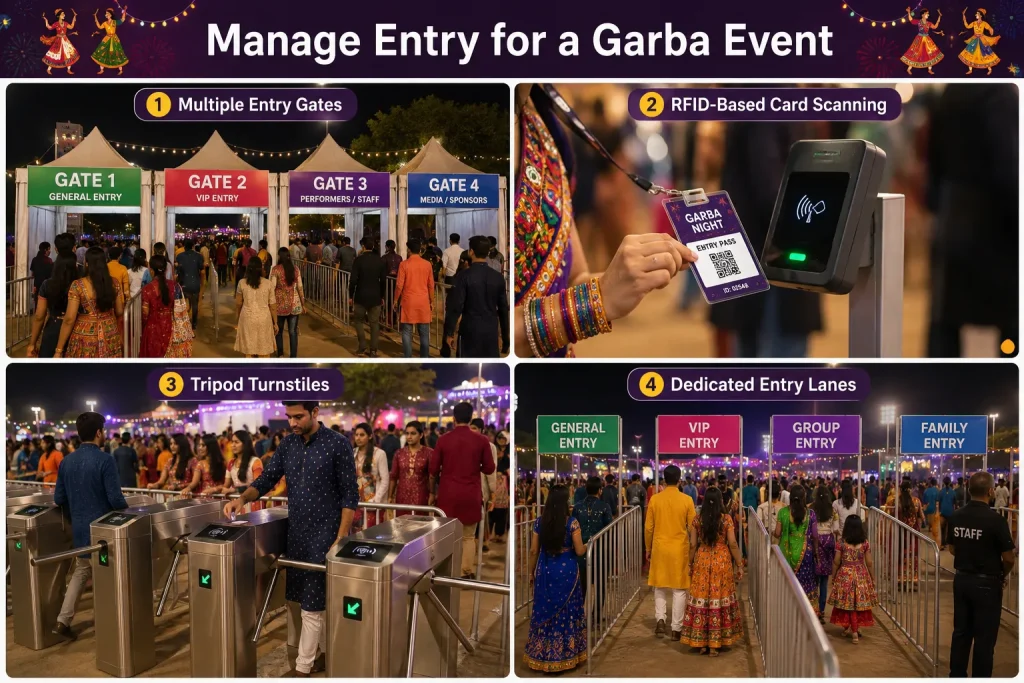
Plan Multiple Entry Gates
Instead of directing everyone to a single entrance, divide attendees across multiple entry gates based on expected crowd volume.
For example, separate gates can be allocated for:
- General attendees
- VIP guests
- Performers
- Volunteers
- Media
- Vendors
Distributing attendees across different gates reduces congestion and speeds up entry.
Use RFID-Based Card Scanning for Faster Entry
Manual ticket verification becomes slow when thousands of people arrive within a short time.
RFID-based card scanning allows attendees to simply tap their RFID card or wristband at the gate. The system instantly verifies their registration and grants access within seconds.
Benefits include:
- Faster attendee verification
- Contactless entry
- Reduced manual errors
- Real-time attendance updates
- Improved queue management
- Better protection against duplicate entries
Install Tripod Turnstiles for Entry
Adding tripod turnstiles for entry helps control the number of people entering the venue. Unlike open gates, tripod turnstiles allow only one validated attendee to pass at a time. This prevents tailgating, improves crowd discipline, and ensures every entry is recorded accurately. Tripod turnstiles also integrate with RFID readers, creating a seamless access process.
Create Dedicated Entry Lanes
Separate lanes make movement faster and more organized. Consider creating dedicated lanes for:
- General admission
- VIP guests
- Staff
- Performers
- Senior citizens
- Families with children
Dedicated lanes reduce confusion and improve the overall attendee experience.
Monitor Entry in Real Time
A live dashboard allows organizers to monitor:
- Number of attendees entering
- Gate-wise crowd volume
- Queue lengths
- Peak arrival periods
If one gate becomes overcrowded, additional gates or staff can be deployed immediately to maintain smooth entry.
Also Read: How to Simplify Navratri Event Ticketing and Attendee Management
2. How to Manage Exit Without Creating Congestion
Exit management is just as important as entry management.
At the end of performances or during scheduled breaks, thousands of attendees may leave the venue within a short period. Without proper planning, exit points can become overcrowded and difficult to manage.
Create Dedicated Exit Gates
Separate exit gates help maintain a one-way flow of people and reduce congestion. Attendees should never compete with incoming visitors at the same access point.
Separate Entry and Exit Flow
Using the same gate for both entry and exit slows movement and increases confusion. Dedicated routes for entering and leaving the venue improve crowd flow while allowing security teams to focus on their specific responsibilities.
Use Tripod Turnstiles for Controlled Exit
Tripod turnstiles for exit are equally useful during exit. Every attendee leaving the venue is automatically recorded, providing organizers with accurate occupancy information at any time. This becomes particularly valuable during emergencies when knowing the exact number of people inside the venue is critical.
Track Every Exit Using RFID
Every exit should be validated using the attendee’s RFID credential.
Exit tracking helps organizers:
- Maintain accurate occupancy
- Support re-entry validation
- Improve attendance reporting
- Monitor crowd movement
Use Clear Signage and Crowd Guidance
Well-placed directional signs and trained volunteers help attendees locate exit gates quickly without creating unnecessary bottlenecks. Emergency exits should remain clearly marked and free from obstructions throughout the event.
Also Check: Registration & Ticketing Platform for Garba, Dandiya, Navratri & Durga Pooja Events
3. How to Manage Re-Entry Efficiently
Unlike many other events, Garba celebrations often involve frequent attendee movement. People may leave the venue to visit food courts, parking areas, nearby shops, or meet friends before returning later. Without a structured re-entry management process, organizers risk duplicate entries, overcrowding, and unauthorized access.
Define a Clear Re-Entry Policy
Before the event begins, establish clear rules regarding re-entry. Common approaches include:
- Unlimited re-entry throughout the event
- One-time re-entry
- Time-based re-entry
- VIP-only re-entry
- Same-day re-entry only
Communicating these policies before the event reduces confusion at the gates.
Record Every Exit
Re-entry management starts with accurate exit tracking. Every attendee leaving the venue should scan their RFID credential so the system records that they have exited. Without this information, validating re-entry becomes much more difficult.
Validate Every Re-Entry Using RFID-Based Card Scanning
When attendees return, RFID-based card scanning instantly checks:
- Registration status
- Previous entry
- Recorded exit
- Re-entry eligibility
Only attendees meeting the event’s access rules are allowed back inside. This automated process is much faster and more reliable than manual verification.
Restrict Unauthorized Re-Entry
Some attendees may attempt to share their passes or allow others to enter using their credentials. Real-time RFID validation combined with access control software helps identify invalid re-entry attempts immediately.
Monitor Re-Entry Activity Live
A centralized dashboard provides visibility into:
- Number of attendees returning
- Peak re-entry periods
- Invalid access attempts
- Current venue occupancy
This information allows organizers to respond quickly if congestion develops at re-entry gates.
How an End-to-End Access Control Solution Simplifies Operations
Managing entry, exit, and re-entry through separate systems often leads to delays, inconsistent attendee records, and limited visibility into crowd movement. An end-to-end access control solution such as Dreamcast connects every stage of the attendee journey into one centralized platform, allowing organizers to manage operations more efficiently.
A typical workflow looks like this:
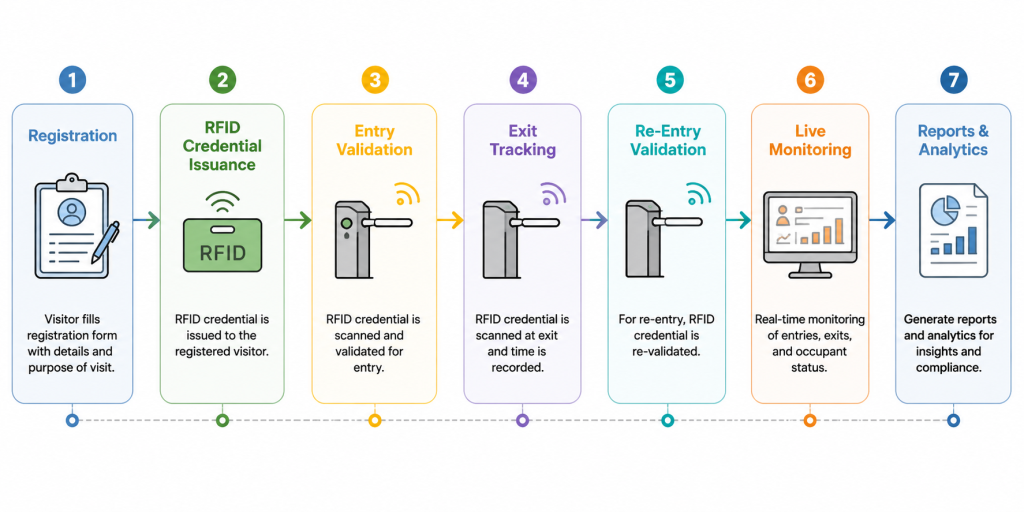
Since every attendee interaction is recorded in real time, organizers always know:
- How many attendees are inside the venue
- Which gates are busiest
- Who has exited the venue
- Who has re-entered
- Whether an access attempt is valid or unauthorized
Instead of relying on multiple disconnected systems, organizers can monitor all access points from a single dashboard. This not only improves operational efficiency but also helps security teams respond faster to crowd-related situations.
How to Prevent Unauthorized Access Throughout the Event
Large public events are often targeted by people attempting to enter without valid credentials. Even a small number of unauthorized entries can create security concerns, increase venue occupancy beyond planned limits, and disrupt event operations.
A strong access control strategy should focus on preventing these situations before they occur.
Verify Every Attendee at the Gate
Every attendee should pass through the same validation process, regardless of their ticket category. Using RFID-based card scanning, the system verifies each credential in real time before access is granted. Invalid, expired, or duplicate credentials can be identified instantly, reducing the chances of unauthorized entry.
Use Tripod Turnstiles to Control Individual Access
Open gates make it easier for multiple people to enter together without proper verification. Tripod turnstiles for entry/exit allow only one validated attendee to pass at a time, helping prevent tailgating and ensuring every entry is recorded accurately.
Assign Zone-Based Access Permissions
Not every attendee needs access to every area of the venue. Different access permissions can be assigned for:
- General attendees
- VIP lounges
- Performer backstage areas
- Media zones
- Staff-only areas
- Technical and control rooms
This ensures attendees can only enter the areas assigned to their credentials.
Monitor Suspicious Activity in Real Time
A centralized monitoring dashboard can quickly identify unusual activity, such as:
- Multiple scan attempts using the same credential
- Repeated invalid scans
- Attempts to access restricted zones
- Unusual crowd build-up at specific gates
Receiving instant alerts allows security teams to respond before the situation escalates.
Best Practices for Smooth Crowd Movement
Technology plays a major role in managing access, but careful planning and trained staff are equally important. Following these best practices can significantly improve crowd movement throughout the event.
Train Staff Before the Event
Every team member should understand:
- Entry procedures
- Exit protocols
- Re-entry rules
- Emergency response plans
- Crowd guidance responsibilities
Well-trained staff can resolve attendee queries quickly and reduce delays at access points.
Test Every Access Point
Before opening the venue, verify that all RFID readers, turnstiles, scanners, and network connections are working correctly.
Testing equipment in advance helps avoid technical issues during peak arrival times.
Keep Backup Equipment Ready
Unexpected hardware failures can happen during any large event.
Maintain backup:
- RFID scanners
- Power supplies
- Internet connectivity
- Handheld validation devices
Having contingency plans minimizes operational disruptions.
Use Clear Directional Signage
Large venues can become confusing, especially during peak hours.
Place visible signs for:
- Entry gates
- Exit gates
- Re-entry points
- VIP access
- Emergency exits
- Parking routes
Good signage reduces confusion and improves crowd flow.
Monitor Crowd Density Continuously
Live monitoring helps organizers identify congestion before it becomes a safety concern.
If one gate experiences heavy traffic, attendees can be redirected to less crowded access points while additional staff is deployed where needed.
Access Management Technology Checklist for a Garba Event
Before the event begins, confirm that the following access control components are ready.
| Requirement | Purpose |
| RFID cards or wristbands | Fast attendee identification |
| RFID readers | Instant access validation |
| Tripod turnstiles for entry/exit | Controlled attendee movement |
| Access control software | Centralized attendee management |
| Live monitoring dashboard | Real-time occupancy tracking |
| Backup handheld scanners | Business continuity |
| Power backup | Uninterrupted operations |
| Internet redundancy | Continuous system connectivity |
| Security personnel | Gate supervision and crowd assistance |
| Directional signage | Faster attendee navigation |
A complete technology setup reduces operational risks while improving the attendee experience.
Conclusion
Managing attendee movement at a 30,000-attendee Garba event requires more than opening additional gates. Organizers need a well-planned strategy that covers every stage of the attendee journey- from the first entry to the final exit and every re-entry in between. By implementing an end-to-end access control solution, supported by RFID-based card scanning, tripod turnstiles for entry/exit, and a clearly defined re-entry management process, organizers can streamline operations, reduce waiting times, and maintain accurate attendee records throughout the event.
Combined with dedicated entry and exit routes, real-time monitoring, trained staff, and proactive measures to prevent unauthorized access, these practices help create a safer, more organized, and enjoyable Garba experience for attendees while giving organizers greater control over event operations.
FAQs
Organizers typically use multiple entry gates, RFID-based card scanning, tripod turnstiles for entry/exit, and real-time monitoring to verify attendees quickly and reduce waiting times.
RFID technology provides faster and more accurate attendee validation than manual ticket checking. It also supports real-time attendance tracking, quicker entry, and improved security.
Every attendee scans their RFID credential when exiting and again when returning. The system checks whether the attendee has a valid registration, a recorded exit, and permission to re-enter before granting access.
Using an end-to-end access control solution, RFID validation, tripod turnstiles, zone-based permissions, and live monitoring helps organizers prevent unauthorized access while maintaining accurate venue occupancy.
Tripod turnstiles regulate one person at a time, preventing tailgating, improving queue discipline, recording every entry and exit, and supporting accurate crowd management.
Simplify Event Planning Hassle-Free