


Table of Contents
Table of Contents
TL;DR
A virtual event is an event held fully online. People join using the internet instead of meeting in person. Webinars, conferences, trade shows, workshops, and product launches can all be held this way. Virtual events save on travel costs, reach people around the world, and give useful data. But they also have problems, like tech issues, screen fatigue, and distractions. Knowing the different types helps you decide when an online event is the right choice.
Introduction
Ten years ago, going to a work event meant booking flights, finding a hotel, and sitting in a crowded hall. Today, millions of people join talks, workshops, and company booths from home. This change grew fast during the pandemic, and it did not go away afterward. Virtual events are now a lasting way for businesses, schools, nonprofits, and communities to connect.
If you are new to the idea, terms like webinar, virtual conference, and hybrid event can be confusing. This guide answers “what is a virtual event” in plain language, covering the definition, how these events work, why they matter, the main types, key features, benefits, challenges, and examples.
What Is a Virtual Event?

A virtual event is an online experience where participants, speakers, and organizers interact through internet-based technology instead of meeting in one place. Attendees join from anywhere on a laptop, tablet, or smartphone to take part in sessions, discussions, and networking.
The entire event happens in a digital environment, with no central venue to travel to. The event space is a web platform, mobile app, or streaming link, and the experience runs on video, audio, chat, and interactive tools.
A virtual event goes beyond a simple video call. A typical meeting is an informal exchange among a small group, while a virtual event is built around a clear goal and serves a larger audience through planned sessions with measurable results. A three-day online summit with keynotes, breakout rooms, and virtual booths qualifies; a quick team check-in does not. For a closer look at how the three formats compare, read this guide on webinar vs video conference vs virtual event.
It also helps to separate virtual events from related formats:
- In-person events are held entirely at a physical venue.
- Virtual events are held entirely online.
- Hybrid events combine an on-site gathering with an online stream for remote attendees.
Virtual events are also called online, digital, web, or remote events. Whatever the label, people take part through technology instead of being physically present.
How Does a Virtual Event Work?
At a high level, a virtual event works by connecting three elements: a digital platform, content, and participants.
The platform. This is the software that serves as the event space, such as a virtual event platform, webinar tool, or streaming service. The platform handles registration, access, live video delivery, chat, and sometimes more advanced features such as virtual lobbies, exhibitor areas, and networking tools.
The content. Speakers and facilitators present live or through pre-recorded sessions. Events can be fully live, fully on demand, or a mix, such as a live keynote paired with a recorded panel for other time zones.
The participants. Attendees join through a unique link or login, then watch sessions, ask questions, visit virtual booths, and connect with others. Their activity, such as sessions joined and time spent, is typically recorded for later review.
Behind the scenes, it all relies on stable internet, streaming technology, and secure access, but for attendees it feels simple: click a link, sign in, and join.
Why Are Virtual Events Important in Today’s World?
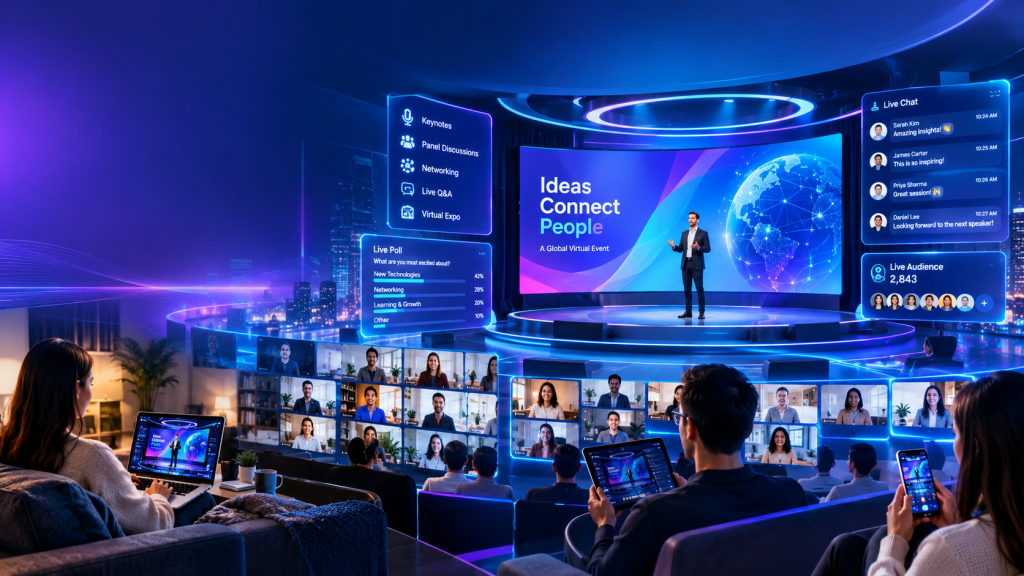
Virtual events matter because they solve problems traditional events struggle with and fit how people now work and learn.
The market data reflects how popular these formats are: webinars generated 45.75% of virtual events market revenue in 2025, while conferences and summits accounted for 42.64% of all virtual event spending
Remote and distributed work is common. Teams are spread across cities and countries, and virtual events bring everyone together without the cost of travel.
Audiences expect flexibility. Professionals, students, and customers want to participate on their own terms, and online formats with on-demand access fit busy schedules far better than a fixed week at a distant venue.
Cost and sustainability pressures are rising. Organizations must control budgets and cut their environmental footprint, and skipping flights, venues, and printed materials lowers both cost and carbon output.
Global reach is now realistic. A small company can host an event that draws attendees from dozens of countries, and a speaker who cannot travel can still address thousands.
Data drives decisions. Digital events generate detailed insights into attendance, interest, and behavior, helping organizers understand their audience and measure return on investment far more precisely than a headcount at the door.
For these reasons, virtual events are no longer a temporary workaround but a strategic format in their own right.
What Are the Different Types of Virtual Events?

Virtual events come in many formats, each suited to a different goal and audience.
Webinars
A webinar is a live or recorded online presentation on a single topic, usually with one or a few speakers and a Q&A segment. Software companies, for example, host product demo webinars to show new features to prospects. It is the most familiar virtual event format, popular for education, lead generation, and thought leadership. To learn more about running a smooth broadcast, see this guide to webinar live streaming.
Virtual Conferences
A virtual conference is a multi-session event, often spanning several days, with keynotes, panels, and breakout tracks, recreating a physical conference online. Industry associations frequently run annual virtual conferences where members learn about trends and best practices from anywhere. For a deeper look at how virtual conferences are run, read this guide on how to execute virtual events and virtual conferences.
Virtual Trade Shows and Expos
Exhibitors set up digital booths where attendees browse products, watch demos, download resources, and chat with representatives. A manufacturing trade show, for instance, can host hundreds of virtual exhibitors that buyers explore at their own pace.
Virtual Summits
A summit is a themed gathering featuring expert speakers on one subject. Summits are common in fields like marketing, wellness, and technology, often bringing together thought leaders from different organizations.
Virtual Workshops and Training Sessions
These interactive, learning-focused events help participants build skills, such as a virtual coding bootcamp or an online leadership workshop. Corporate learning teams also use them for onboarding and professional development.
Virtual Career Fairs
Employers and job seekers meet online through video chats, text conversations, and digital booths. Universities and recruiters use them to connect candidates with employers regardless of location. For more on how these events work, read this guide to virtual recruitment events.
Virtual Product Launches
Companies unveil new products through a live-streamed presentation, often with demos, executive remarks, and audience Q&A. Many technology brands now reach a worldwide audience with a single online broadcast.
Virtual Networking Events
These gatherings focus on building relationships, with attendees matched into one-on-one or small-group conversations. Professional communities and alumni groups often use this format. To explore the benefits and ideas, read this guide to virtual networking events.
Virtual Town Halls and Internal Company Events
Organizations hold all-hands meetings, leadership updates, and team celebrations online so employees across offices and time zones can take part together. To learn why and how companies host them, read this guide to a virtual town hall meeting for employees.
Virtual Fundraisers and Community Events
Nonprofits host online galas, auctions, and awareness campaigns to raise money and rally supporters beyond their local area.
Virtual Concerts, Festivals, and Entertainment Events
Musicians, comedians, and performers stream live shows to fans worldwide, and some festivals build immersive digital spaces where audiences watch and interact. For a festive example, see these virtual Holi celebration ideas.
Hybrid Events
A hybrid event is not purely virtual but is closely related: it combines an in-person gathering with a live online stream so remote attendees can join those on site. To see how organizers keep both audiences involved, read these hybrid event engagement ideas.
What Are the Key Characteristics of a Virtual Event?
Most virtual events share a few defining traits.
Online access. Participation happens through a browser, app, or streaming link, with no physical venue required.
Location independence. Attendees can join from anywhere with a reliable connection.
Live and on-demand delivery. Content may be live, recorded, or both, giving attendees flexibility and extending its life.
Interactive tools. Live chat, polls, Q&A panels, breakout rooms, and virtual booths let participants engage rather than just watch.
Scalability. A virtual event can host dozens or tens of thousands of attendees without physical space limits.
Registration and access control. Most events use registration pages and unique login links to manage attendance and keep content secure.
Data and analytics. Platforms record attendance, session views, and participation, giving organizers measurable insight.
Multimedia content. Video, slides, audio, and downloadable resources replace printed brochures and signage.
Branding and customization. Organizers can shape the look of the digital space, from logos and colors to custom lobbies and sponsor placements.
Together, these traits set a true virtual event apart from an ordinary online meeting.
What Are the Benefits of Virtual Events?
The popularity of virtual events comes from a clear set of advantages.
Lower Costs
There are no venue rentals, travel expenses, hotel bills, or catering fees. Attendees save on flights and lodging, and organizers usually spend far less than on an equivalent in-person event.
According to AM World Group, virtual events cost roughly 75% less per attendee than in-person events.
Broader Reach
People who cannot attend in person because of distance, cost, visa limits, or mobility challenges can still participate, widening the audience and bringing in diverse perspectives.
Greater Scalability
Adding more attendees does not require a bigger room. A well-chosen platform can support large audiences with little additional cost per person.
Convenience and Flexibility
Attendees save time on commuting and can often watch sessions on their own schedule through recordings. This is especially valuable for busy professionals and people in different time zones.
Valuable Data and Insights
Every click, view, and question can be tracked. Organizers learn which topics resonated, which sessions drew the most attention, and who showed genuine interest. This supports smarter decisions and clearer measurement of results.
Reusable Content
Sessions can be recorded and repurposed as on-demand videos, clips, articles, or training material. A single event can keep generating value long after it ends.
Environmental Sustainability
Fewer flights, less printed material, and no physical venue energy use mean a smaller carbon footprint.
Accessibility and Inclusion
Features such as captions, transcripts, adjustable playback, and translation options can make events easier to access for people with different needs and language backgrounds.
Faster Turnaround
Because there is no venue to book months in advance, virtual events can often be organized and launched more quickly, which helps organizations respond to timely opportunities.
What Are the Challenges of Virtual Events?
Virtual events are powerful, but they are not without drawbacks. Being aware of these limitations gives a balanced picture.
Technology dependence. A poor internet connection, platform glitches, or audio problems can disrupt the experience for both presenters and attendees.
Screen fatigue. Staring at a screen for hours is tiring. Attention spans can shrink, and attendees may drop off before sessions end.
Distractions. At home or at work, participants face emails, notifications, and household interruptions that compete with the event.
Limited personal connection. Digital interaction rarely matches the warmth and spontaneity of face-to-face conversation. Building genuine relationships online can feel harder.
Lower commitment. Because registration is easy and there is no travel investment, people may sign up and never show up, which can lead to lower attendance rates than expected. Organizers often use incentives to encourage attendance and participation; see these virtual gift ideas for events.
Security and privacy concerns. Online events involve personal data and sometimes confidential content, which raises questions about data protection and unauthorized access.
Time zone differences. A global audience means that live sessions will not suit everyone, so some attendees will join at inconvenient hours or rely on recordings.
Digital divide. Not everyone has fast internet or suitable devices, which can exclude some potential participants.
Sponsor and exhibitor value. Some sponsors feel that digital booths do not generate the same quality of leads as an in-person handshake, so proving value can take extra effort.
Virtual Event Best Practices
Without going into detailed planning, a few guiding principles consistently separate successful virtual events from forgettable ones.
Define a clear purpose. Every virtual event should serve a specific goal, whether that is education, lead generation, community building, or brand awareness. A clear purpose shapes the format that makes sense.
Choose the right format. A webinar suits a focused topic, while a multi-day conference suits a broad program. Matching the format to the goal prevents wasted effort.
Respect attention spans. Shorter sessions and focused content generally hold interest better than long, unbroken broadcasts.
Prioritize reliability. Dependable technology and good audio and video quality are essential. A strong message loses impact if people cannot hear or see it properly.
Keep content accessible. Offering captions, recordings, and clear instructions helps more people participate fully.
Measure results. Reviewing attendance and participation data afterward shows what worked and what to improve next time.
These principles keep the focus on understanding what makes a virtual event effective, rather than on the mechanics of running one.

Conclusion
A virtual event is an online gathering that connects people through digital technology, replacing the need for a shared physical space. It can take the shape of a simple webinar, a multi-day conference, a bustling trade show, a career fair, or a global product launch. What unites them is online access, location independence, interactive tools, scalability, and the ability to capture useful data.
The advantages are significant: lower costs, wider reach, greater flexibility, reusable content, and a smaller environmental footprint. At the same time, challenges such as technology problems, screen fatigue, distractions, and weaker personal connection remind us that virtual events work best when they are chosen and designed with a clear purpose.
As work, learning, and community life continue to move across borders and screens, virtual events will keep growing in importance. Knowing what a virtual event is, what types exist, and what makes each one valuable gives you the foundation to decide when an online format is the right fit, and to appreciate the role it now plays in how the world gathers.
FAQs
A virtual event is an event that takes place online. Instead of traveling to a venue, participants join through the internet using a computer or mobile device to watch, listen, and interact.
A webinar is one type of virtual event. It usually involves a single presentation on one topic. A virtual event is a broader term that also includes conferences, trade shows, summits, career fairs, and other multi-part online experiences.
A virtual event is fully online. A hybrid event combines a physical gathering with an online component, so some attendees are present on site while others join remotely.
Common examples include online conferences, product launch broadcasts, virtual job fairs, live-streamed concerts, company town halls, online trade shows, and training workshops.
Both exist. Many webinars and community events are free, while large conferences, summits, and premium workshops often charge a fee, depending on the goal, content, and audience.
Across All Event Formats With Our Event Tech Suite