



Table of Contents
The DPDP Act affects event registration because organizers collect and process attendees’ digital personal data. They need to consider what data they collect, why they collect it, how they inform attendees, who can access it, how it is protected, and when it should be deleted.
The DPDP Act 2025 for events requires organizers to handle attendee personal data responsibly across registration, processing, sharing, security, retention, and applicable data principal rights.
Event registration is one of the first points where an organizer collects personal data from an attendee. A typical registration form may ask for a name, email address, phone number, organization, job title, ticket details, and other information.
That information may then move through several event processes, including ticketing, payment, digital badges, QR check-in, access control, networking, and attendee communication.
This makes data protection relevant beyond the registration form itself.
India’s Digital Personal Data Protection Act, 2023 (DPDP Act) establishes the legal framework for processing digital personal data, while the Digital Personal Data Protection Rules, 2025 provide detailed requirements for implementing several provisions of the Act. The Rules were notified on November 13, 2025, with different provisions coming into effect in phases.
For event organizers, the important question is not simply “Does DPDP apply to events?” It is:
How should our registration and attendee-data processes change because of DPDP?
The answer covers the complete data lifecycle, from the moment an attendee submits a registration form to what happens to their information after the event. In this article, we’ll cover how DPDP affects attendee data collection, registration forms, consent, security, data sharing, retention, and event technology across the attendee journey.
Table of Contents
How Does DPDP Change Event Registration?
The biggest change is that organizers need to think beyond collecting attendee information. They need to understand the purpose, handling, and lifecycle of that information.
A typical registration process may look like:
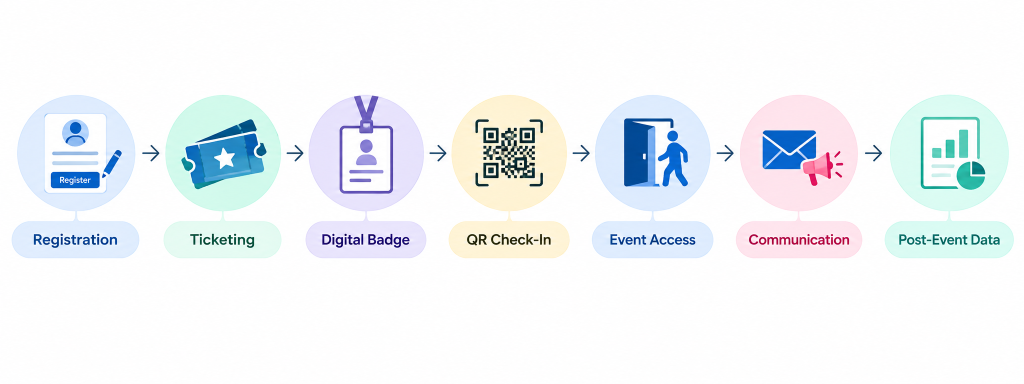
At each stage, personal data may be processed.
Under the DPDP framework, organizations that determine the purpose and means of processing personal data can have responsibilities as Data Fiduciaries. The individual is referred to as the Data Principal. The Act also places obligations on Data Fiduciaries for processing carried out on their behalf by Data Processors.
For an event organizer, this means reviewing:
- What attendee data is collected
- Why is each type of data needed
- What information is provided to attendees
- When consent is the applicable basis for processing
- Who can access the data
- How is the data protected
- Whether it is shared with other parties
- How long is it retained
- How applicable attendee rights and requests are handled
So, DPDP does not simply affect the registration form. It affects the way registration data is managed after it has been collected.
What Does DPDP Mean for Attendee Data Collection?
A registration platform may allow organizers to create dozens of fields. DPDP considerations make it important to assess whether those fields are actually needed for the stated purpose.
For example, a conference registration form may request:
| Data | Possible event purpose |
| Name | Identify the attendee |
| Registration confirmation and event communication | |
| Mobile number | Event-related communication or verification |
| Company | Networking or attendee identification |
| Job title | Professional networking |
| Ticket category | Access and event management |
| Dietary preference | Catering arrangements |
The important question is:
Why is this information being collected?
If an organizer asks for an attendee’s home address but does not need it for registration, ticketing, communication, or another defined purpose, that field should be reviewed and removed. This makes purpose-driven data collection an important part of designing an event registration process.
How Does DPDP Affect Event Registration Forms?
The registration form is often the first place where an attendee interacts with an organizer’s data-processing practices.
The DPDP Act requires notice before or at the time of requesting consent, where consent is the applicable basis. The DPDP 2025 Rules provide more detail about what that notice should contain. The notice should be clear, understandable, and provide an itemised description of the personal data being collected and the purpose for processing it.
For event organizers, this means a registration form should not treat privacy information as an afterthought.
For example, instead of using a vague statement such as:
“Your information may be used for event purposes.”
An organizer can provide clearer information explaining what information is collected and why.
For example:
“We collect your name and email address to process your registration and provide event-related communications.”
The exact notice should reflect the organizer’s actual processing activities and applicable legal requirements.
What Changes Does DPDP Bring to Event Registration Consent?
Consent is an important part of the DPDP framework, but organizers should not assume that every piece of event-data processing is automatically handled in the same way.
Where consent is the applicable basis, the Act requires consent to be free, specific, informed, and unambiguous, with a clear affirmative action. The request for consent should also be presented in clear and plain language.
This matters when a registration form has several different purposes.
For example, an organizer may need an attendee’s email address to send:
- Registration confirmation
- Event access information
- Schedule updates
Those communications may be different from optional promotional communications.
Therefore, organizers should distinguish between information necessary for the event and additional uses of attendee data, where applicable.
The goal is to make it understandable to the attendee what they are agreeing to and why.
How Does DPDP Affect Attendee Data After Registration?
Registration does not end when an attendee clicks “Submit”.
The information collected during registration may be used to generate a ticket or digital badge, validate entry, and manage attendance.
For example:
- Attendee registers
- The registration record is created
- A digital ticket or M-Badge is issued
- QR code is scanned at the venue
- Entry is validated
- Attendance information is recorded
Each stage can involve the processing of personal data.
This is why organizers need to look at DPDP across the entire attendee-data lifecycle, rather than treating registration as an isolated activity.
Who Can Access Attendee Registration Data?
Event data can be accessed by different teams and service providers.
Depending on the event, these may include:
- Registration teams
- Event organizers
- Check-in staff
- Event technology providers
- Communication providers
- Payment service providers
- Other authorised service providers
Under the DPDP framework, organisers should understand who is processing attendee data and on whose behalf. The Data Fiduciary remains responsible for processing carried out by a Data Processor on its behalf, making vendor selection and data-processing arrangements important considerations.
Organisers can also reduce the number of separate vendors involved by choosing an all-in-one event technology provider such as Dreamcast. A single platform can support multiple parts of the attendee journey, including event registration, ticketing, badge printing, digital badges, and event check-in, instead of requiring separate third-party solutions for each process.
Additionally, access should also be appropriate to the person’s role.
For example, a check-in staff member may need to see an attendee’s name and registration status. They may not need access to every field collected during registration.
This makes access control and role-based access important considerations when selecting event technology.
How Does DPDP Affect the Security of Attendee Data?
Security is another major area affected by the DPDP framework.
The DPDP Act requires Data Fiduciaries to take reasonable security safeguards to prevent personal data breaches. The 2025 Rules provide additional detail on security safeguards, including measures such as encryption, masking or tokenisation, access controls, logging and monitoring, backups and appropriate contractual provisions with Data Processors.
For an event organizer managing 10,000 or 100,000 attendee records, this has a practical impact.
It means organizers should ask:
- Where is attendee data stored?
- Who can access it?
- What security measures are used?
- Are access activities monitored?
- How are third-party processors managed?
- What happens if a data breach occurs?
- Is there a backup and recovery process?
Note: The 2025 DPDP Rules also establish requirements concerning notification of certain personal data breaches to the Board and affected Data Principals.
How Does DPDP Affect Sharing Attendee Data With Third Parties?
Attendee information may sometimes need to be processed by other organizations, such as event technology providers, communication services, or other vendors.
This makes it important for organizers to understand:
- What data is being shared or processed?
- Why is it being processed?
- Who is processing it?
- What contractual and security arrangements apply?
Sponsor and exhibitor access needs particular attention because sharing attendee information for a sponsor’s own purposes can be different from processing information to deliver the event.
What Does the DPDP Act Say About Sharing Attendee Data With Third Parties?
Under the DPDP Act, event organizers need to be careful when attendee information is shared with other organizations, such as event technology providers, communication platforms, or other vendors.
Organizers should understand:
- What data is being shared or processed?
- Why is the data being used?
- Who will have access to it?
- What security and contractual safeguards are in place?
The DPDP Act also makes it important to clearly define the purpose for which personal data is collected and used. If a third party processes attendee data on behalf of the organizer, the organizer should ensure that appropriate arrangements and safeguards are in place.
Sponsor and exhibitor access needs extra attention. Sharing attendee data with a sponsor for the sponsor’s own marketing or business purposes can be different from using a service provider to help deliver the event.
What Happens to Attendee Data After an Event Under DPDP?
The DPDP Act also makes it important for event organizers to think about what happens to attendee information after an event ends.
Registration details can easily stay in databases for years, even when they are no longer needed. Organizers should have a clear plan for how long attendee data should be kept and when it should be deleted.
For example, some information may need to be kept for a specific legal or business reason, while other information may no longer be needed once the event is over.
The DPDP Act provides for erasing personal data when it is no longer needed for the purpose for which it was collected, subject to applicable legal requirements.
So, after an event, organizers should ask:
Which attendee data do we still need, why do we need it, and how long should we keep it?
This helps organizers avoid keeping personal data longer than necessary.
What Should Organizers Change in Their Event Registration Process?
A practical DPDP-focused registration process can be reviewed in four stages.
Before registration
- Identify the personal data required.
- Define the purpose for collecting it.
- Review registration fields.
- Prepare the required notice.
- Identify applicable consent requirements.
- Review third-party processors.
During registration
- Clearly explain the relevant data processing.
- Collect information for defined purposes.
- Avoid unnecessary fields.
- Separate additional or optional purposes where appropriate.
- Maintain appropriate records.
During the event
- Control access to attendee information.
- Protect digital badges and QR credentials.
- Secure check-in and access-control systems.
- Limit data visibility based on roles.
After the event
- Review which data needs to be retained.
- Delete or erase information when applicable.
- Manage attendee requests and applicable rights.
- Review third-party data handling.
- Maintain processes for personal data breaches.
What Should Organizers Look for in Event Registration Technology?
DPDP considerations should also influence the choice of event technology.
Organizers should evaluate more than registration speed or form design. They should understand how a platform handles attendee data across registration, ticketing, digital credentials, and onsite access.
Important areas to evaluate include:
- Customisable registration fields
- Clear notice and consent workflows
- Access controls
- Attendee data security
- Digital tickets and M-Badges
- QR-based check-in
- Data processing by third parties
- Data retention and deletion processes
- Security and breach-response processes
Platforms such as Dreamcast connect event registration, ticketing, digital M-Badges, and QR-based check-in within a connected event technology workflow.
The important point for organizers is not to rely on a general claim of “DPDP compliance.” Instead, they should ask technology providers what controls, processes, contracts, and security measures they actually have in place to support responsible attendee-data management.

DPDP Event Registration Checklist
Before launching an event registration process, organizers can ask:
- Data: Are we collecting only the information we need?
- Purpose: Do we know why each category of data is being collected?
- Notice: Have we clearly explained the relevant processing?
- Consent: Is consent being obtained where it is the applicable basis?
- Access: Who can view attendee information?
- Security: What safeguards protect the data?
- Processors: Which third parties process the information?
- Sharing: Are there any disclosures to sponsors or other parties?
- Retention: How long should different categories of information remain available?
- Breaches: Do we have a process for responding to personal data breaches?
Conclusion
The biggest impact of the DPDP Act on event registration is the shift from simply collecting attendee information to actively managing its entire lifecycle.
For event organizers, this means looking at every stage:
- Collect
- Inform
- Process
- Protect
- Access
- Share
- Retain
- Delete
Registration forms, ticketing, digital badges, and QR check-in are all connected parts of that journey.
A DPDP-focused event strategy therefore starts before an attendee submits a registration form and continues until the organizer no longer needs the relevant personal data.
Important Note: This article is for general informational purposes and is not legal advice. Event organizers should obtain professional advice when assessing obligations for their specific processing activities.
FAQs
It can apply when an event organizer processes digital personal data within the scope of the Act. Registration information such as names, email addresses and phone numbers can therefore become subject to the DPDP framework.
Digital personal data relating to an identifiable individual can fall within the framework. For events, this can include registration, contact, ticketing, digital badge, and attendance-related information, depending on how it is processed.
Sponsor data sharing needs careful consideration. Organizers should assess the purpose, applicable legal basis, attendee disclosures, contractual arrangements, and responsibilities involved before sharing or permitting access to personal data.
Organizers should implement appropriate technical and organizational safeguards, control access, manage Data Processors, and maintain processes for responding to personal data breaches and applicable Data Principal requests.
DPDP obligations can remain relevant after an event because personal data may continue to be stored or processed. Organizers should review whether information is still necessary and follow applicable requirements concerning retention and erasure.
Simplify Event Planning Hassle-Free